
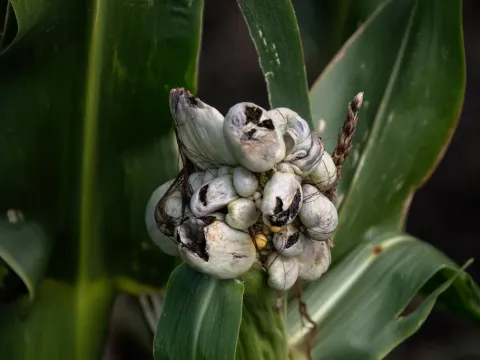
Common smut of corn
Mexican corn
The causative agent of the disease is the basidiomycete fungus Ustilago maydis. It is an obligate parasite that specifically infects corn plants.
What the section contains
Common smut of corn
The fungus survives as teliospores in the soil or on crop residues for several years. In the spring, these spores germinate to form basidia, which produce infectious sporidia.
Infection occurs when sporidia contact the meristematic tissues of the corn plant. The fungal hyphae penetrate the cells, triggering abnormal growth patterns.
This process results in the formation of characteristic galls on various parts of the host plant. Inside these galls, a massive number of new spores is produced.
The survival and dispersal of Ustilago maydis depend on the environmental conditions and the availability of susceptible host tissue throughout the season.
Common smut affects all above-ground parts of the corn plant, including leaves, stems, ears, and tassels, leading to significant physiological stress.
Damage to the ears is particularly devastating, as it can result in the complete transformation of grain into a mass of fungal spores, rendering the crop unmarketable.
When the stem is infected, it can cause stunted growth, bending, and increased susceptibility to stalk breakage or lodging, complicating harvest.
Reduction in the photosynthetic area, caused by leaf galls, leads to poor ear filling and reduced grain weight, directly impacting the final yield.
In cases of severe infestation, yield losses can be substantial, making it a critical disease for corn growers to monitor and manage effectively.
The disease can occur throughout the growing season, with the highest susceptibility in young, actively growing plant tissues.
Fungal activity is favored by warm, humid weather conditions, with optimal temperatures for spore germination ranging between 20°C and 25°C.
Environmental stress, such as drought followed by rainfall, often promotes infection outbreaks as young plant tissues become highly vulnerable.
The spores are dispersed by wind and rain splashes, and their dissemination is continuous as long as the temperature and humidity remain favorable.
Mechanical damage to plants during cultivation often serves as an entry point for the fungus, leading to a higher incidence of galls in treated fields.
The most visible symptom is the development of galls, which are initially covered by a white or grayish membrane and appear fleshy.
As the galls mature, the membrane ruptures, revealing a powdery mass of dark, blackish-brown teliospores ready for dissemination.
Galls vary in size depending on the infection site: leaf galls are generally smaller, while ear and stem galls can grow to be quite large and conspicuous.
The plant may exhibit signs of distortion, including twisted leaves or ears, due to the hyperplastic growth induced by the fungus.
These fungal swellings are unmistakable diagnostic features that allow farmers to identify infected plants easily in the field.
The primary control measure is the use of genetically resistant corn hybrids, which are effective at limiting the establishment of the pathogen.
Crop rotation is essential to prevent the buildup of spores in the soil; a minimum interval of 3 to 4 years between corn crops is highly recommended.
Good agricultural practices, such as deep plowing to bury crop residues, help to accelerate the decomposition of infected debris and reduce inoculum pressure.
Integrated pest management to control stalk-boring insects is crucial, as their feeding damage creates entry points for the fungal spores.
Balanced fertilization, specifically avoiding excess nitrogen, helps the plants maintain robust health and natural resistance against the fungus.