
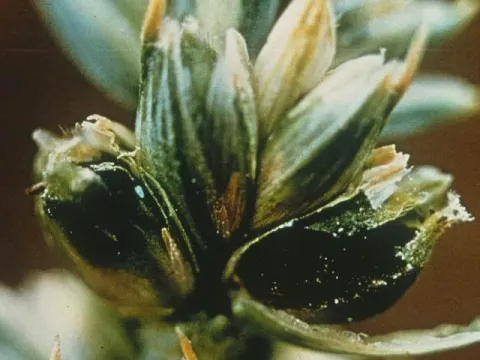
Common bunt of wheat
Tilletiacaries foetida
Common bunt of wheat is a fungal disease caused by the pathogen Tilletia caries (syn. Tilletia tritici). It is an obligate parasite belonging to the kingdom Fungi and the class Ustilaginomycetes, specifically targeting wheat and other related grass species.
What the section contains
Common bunt of wheat
The infection process begins at the seedling stage. Teliospores, which persist on the seed surface or in the soil, germinate and produce basidiospores that infect the wheat seedling before it emerges from the soil.
Once inside the host, the mycelium grows systematically through the plant tissues. It remains largely invisible until the plant reaches the heading stage, at which point the fungus colonizes the developing ovaries of the wheat kernels.
The fungus replaces the internal contents of the grain with a mass of teliospores, forming what is known as a "bunt ball." These balls are covered by the pericarp, maintaining the shape of a normal kernel but appearing grayish-brown.
Development is heavily favored by cool, moist soil conditions, with temperatures ranging from 5°C to 12°C. Consequently, early-planted winter wheat is often at a higher risk of being exposed to these conditions during the vulnerable germination phase.
The primary damage caused by common bunt is a direct reduction in grain yield. Since the pathogen destroys the interior of the wheat kernels, these grains are lost, and the infected spikes produce significantly less weight compared to healthy plants.
Economic damage extends beyond yield reduction to grain quality. During harvest, bunt balls are often crushed, releasing spores that contaminate the entire harvest, creating a "fishy" or rotten odor due to trimethylamine accumulation.
Contaminated grain is usually rejected at elevators and is unsuitable for milling. The spores discolor flour, making it visually unappealing and giving it a distinct, repulsive smell that renders it useless for food production.
In addition to direct losses, systemic infection can result in physiological stress, causing stunted plant growth, abnormal tillering, and an overall weakening of the wheat crop, making it more susceptible to environmental stressors.
Severe infestations can lead to significant financial losses for farmers, as an entire field's crop may become unmarketable if the level of spore contamination exceeds established quality standards.
Symptoms are most visible during the grain-filling stage. Infected spikes remain green longer than healthy ones and often have a more upright orientation because the bunt balls are lighter than heavy, healthy grains.
Upon closer inspection, the glumes of the spikelets spread wide apart. Instead of a normal seed, a firm, rounded bunt ball is visible. When broken, these balls reveal a black, powdery mass of spores that disperses easily upon contact.
A distinctive fishy odor in the field during harvest is a definitive sign of common bunt presence. This scent is caused by the release of amines from the spores and is a clear indicator of a major disease outbreak.
In some varieties, the plants themselves may appear slightly shorter or exhibit a more compact, bushy appearance. The glumes may also show a subtle blue-green discoloration just before the grains reach maturity.
Early diagnosis via laboratory seed testing is highly effective. Even if kernels appear visually healthy, the presence of teliospores on the pericarp can be detected through microscopic analysis and washing tests.
The most effective strategy for managing common bunt is the systematic treatment of seeds with fungicides. Modern systemic products are highly effective at killing spores on the seed surface and protecting the seedling during initial growth.
Crop rotation is a vital cultural practice, as it helps reduce the buildup of soil-borne spores. By rotating wheat with non-host crops, the viability of the inoculum in the field is significantly decreased over time.
Selecting the right planting window is essential for minimizing risk. By avoiding soil conditions that favor slow seedling emergence, farmers can reduce the timeframe during which the crop is most vulnerable to infection by Tilletia caries.
Utilizing disease-resistant wheat varieties is the most sustainable long-term solution. Many breeding programs focus on incorporating specific resistance genes that prevent the pathogen from colonizing the plant tissue.
- Application of seed treatment fungicides.
- Implementation of a 1-2 year crop rotation.
- Use of certified, disease-free seed stock.
- Adjusting planting dates to favor rapid emergence.
- Rigorous grain cleaning to remove bunt balls from seed lots.