
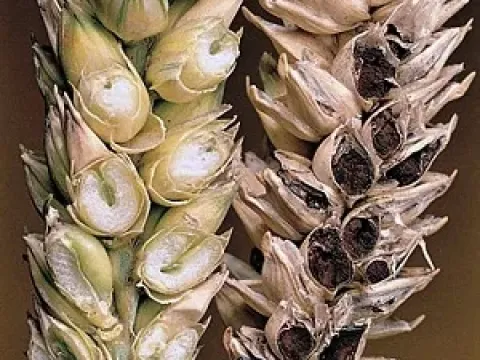
Common bunt of wheat
Tilletiacaries laevis
Common bunt of wheat is caused by the fungus Tilletia caries (syn. Tilletia tritici), a member of the Basidiomycota division. It is a specialized pathogen that primarily targets wheat species.
What the section contains
Common bunt of wheat
The disease cycle begins when teliospores contaminate the seed surface or remain in the soil. Upon germination of the seed, the fungus infects the seedling, and the mycelium grows systematically with the developing plant.
As the plant progresses to the heading stage, the fungal hyphae invade the ovaries of the developing grain. The entire content of the grain is replaced by a dense mass of black, powdery teliospores.
These spores are spherical, marked with a reticulate pattern, and can survive for several years in the soil or on grain, serving as the primary inoculum for future infections.
Environmental factors are crucial: infection typically occurs in cool, moist soils with temperatures ranging from 5 to 15°C. This makes early or late planting times critical factors for disease development.
The primary economic impact is the direct loss of grain yield. Infected plants often produce "bunt balls" instead of healthy kernels, leading to significant reduction in harvest weight.
The quality of harvested wheat is severely compromised. Bunt spores contain trimethylamine, which imparts a distinct, unpleasant "fishy" odor to the grain and flour, making it unsuitable for commercial food production.
Secondary losses occur during the harvesting process as bunt balls are crushed, covering healthy grains with spores. This contamination reduces the market value and requires expensive cleaning procedures.
Severe infestations can lead to substantial financial losses for farmers, as contaminated grain is often rejected by elevators or sold at significantly lower prices.
Beyond yield loss, the accumulation of fungal spores in the soil increases the risk for subsequent wheat crops, making long-term integrated pest management necessary for sustainable production.
Identifying common bunt in the field is difficult until the heading stage. Infected plants usually appear slightly stunted, and the spikes may remain green longer than healthy ones.
The glumes of an infected spike are often pushed apart by the swollen bunt balls inside, giving the head a loose, open appearance. This is a characteristic diagnostic feature for field inspection.
When an infected seed is crushed, it does not release starchy endosperm but instead emits a mass of dark spores with a pungent, fish-like smell that is highly identifiable.
During the harvest, the bunt balls shatter, spreading the spores throughout the field and onto the remaining healthy grain, which ensures the persistence of the pathogen in the system.
- Stunted growth of infected wheat tillers.
- Loose glumes showing the presence of bunt balls.
- Dark, powdery mass instead of starch in the grain.
- Fishy odor of the harvested grain crop.
The most effective strategy is the use of certified, disease-free seed. Cleaning and grading seeds is essential to remove light bunt balls from the healthy grain lot.
Seed treatment with systemic or contact fungicides is the industry standard for preventing infection. Proper application ensures the destruction of spores present on the seed coat before planting.
Crop rotation is an effective cultural practice, as it breaks the life cycle of the fungus by preventing it from finding a suitable host plant in the soil for an extended period.
Adjusting planting dates to avoid cool, wet soil conditions during germination can significantly lower the incidence of common bunt infection in susceptible fields.
Planting resistant wheat varieties is the most sustainable approach, as it reduces the reliance on chemical inputs and ensures stable productivity even under high disease pressure.