
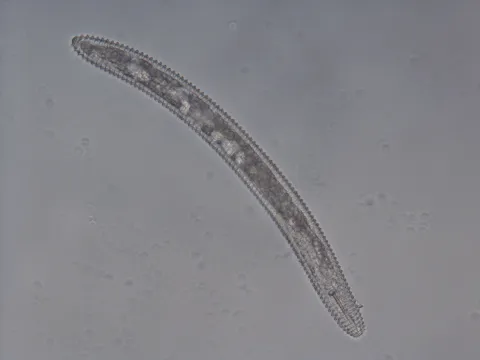
Ring nematode
Mesocriconema ornatum
Mesocriconema ornatum, commonly known as a ring nematode, belongs to the phylum Nematoda, class Chromadorea. It is identified by the distinct, thick cuticular rings encircling its body, which gives the genus its common name and distinguishes it from other soil-borne nematodes.
What the section contains
Ring nematode
This species is an ectoparasitic nematode that resides primarily in the soil surrounding the root zone. Both adults and larvae possess a prominent, elongated stylet used for piercing root tissues to feed on plant cells.
Systematically, it is a highly specialized plant-parasitic nematode that thrives in various soil types but demonstrates a clear preference for coarse-textured, sandy soils that allow for easier movement and oxygen availability.
Unlike endoparasitic nematodes that burrow deep into roots, the ring nematode remains an ectoparasite, feeding externally. However, its feeding behavior causes consistent physiological stress to the host plant.
The life cycle encompasses the egg stage, four larval stages, and the adult stage. Development occurs entirely within the soil environment, often reproducing through parthenogenesis, which allows populations to build up rapidly under favorable conditions.
The pest affects a wide range of agricultural crops, including fruit trees, small fruits like strawberries, as well as various vegetable and ornamental plants. Sandy soils are particularly susceptible to severe infestations.
Feeding occurs by puncturing root hairs and the epidermal cells of the cortex. These feeding wounds cause localized necrosis and create entry points for opportunistic soil-borne fungi and bacteria, leading to complex root rot diseases.
The primary impact of Mesocriconema ornatum is the suppression of root system development. Infested plants exhibit stunted growth, reduced vigor, and a significantly diminished root mass, which severely limits water and nutrient uptake.
Visible symptoms on the host include chlorosis and general lack of vitality. In severe cases, particularly in young or newly transplanted crops, high populations of this nematode can lead to poor establishment and plant death.
Crop losses are frequently associated with the reduced efficiency of the root system, causing the plant to be hypersensitive to drought, heat stress, and nutrient deficiencies, resulting in lower total yields.
The activity and reproduction of Mesocriconema ornatum are strongly dependent on soil temperature and moisture levels. Peak population growth typically occurs during warm seasons when soil temperatures range between 20°C and 28°C.
During cold winters or unfavorable periods, these nematodes enter a survival state (diapause), remaining dormant in the soil until environmental conditions become suitable for active feeding and reproduction.
Natural migration through the soil profile is limited; however, the nematode is easily spread over long distances by human activity, including the movement of infested soil on farm machinery, tools, and non-certified plant nursery stock.
Maximum damage is generally observed during the periods of active root growth, as the parasite capitalizes on the nutrient-rich tissues provided by the plant’s new, developing root structures.
The spread of the pathogen is further facilitated by irrigation practices and natural drainage, which can wash larvae and adults into lower soil layers or adjacent plots of land.
Diagnosis is challenging because symptoms are non-specific and often mimic nutrient deficiencies or water stress. The most common sign is a patchy appearance in fields, where growth is visibly uneven and stunted.
Examination of the root system under magnification often reveals lesions, tissue browning, and a noticeably reduced number of fine root hairs necessary for water absorption compared to healthy plants.
In diagnostic laboratory settings, Mesocriconema ornatum is identified by extracting the nematodes from soil core samples collected from the rhizosphere and performing a microscopic count.
A secondary indicator of infestation is a lack of response to fertilization, as the damaged roots are unable to absorb the added nutrients efficiently, causing the plant to remain stunted despite sufficient soil fertility.
Frequent wilting, even when soil moisture is adequate, serves as a common behavioral indicator of root health impairment caused by heavy nematode infestation during peak daytime temperatures.
Managing the ring nematode requires an integrated pest management (IPM) approach. Crop rotation is a vital strategy, as growing non-host crops helps to starve the nematode population over time.
The use of clean, certified planting stock is the most important preventative measure. Since this nematode is largely spread through the transport of infested soil, rigorous sanitation is necessary.
Good agronomic practices, such as deep plowing to break up soil and the addition of organic amendments to stimulate beneficial soil microbes, can help suppress nematode populations naturally.
Chemical nematicides can be utilized when populations exceed economic thresholds; however, they require careful application due to their high toxicity and the necessity of observing strict pre-harvest intervals.
Biological control agents, particularly those utilizing antagonistic fungi that target nematode eggs and juveniles, are increasingly used to lower population densities while maintaining an environmentally sustainable growing environment.