
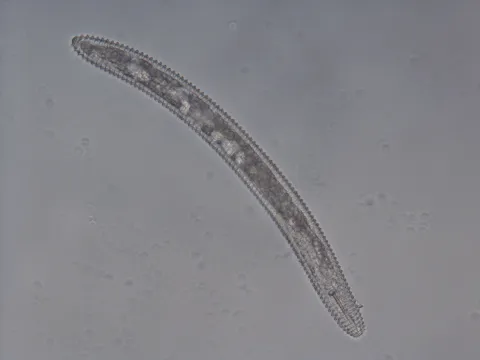
Ring nematode
Macroposthonia xenoplax
The ring nematode (Macroposthonia xenoplax) is a microscopic soil-dwelling pathogen classified under the phylum Nematoda, class Chromadorea, and order Rhabditida. It is an ectoparasite that feeds externally on plant roots.
What the section contains
Ring nematode
This species is characterized by distinct, heavy ring-like annulations on its cuticle, which gives the body a segmented appearance. Adult nematodes are typically small, ranging from 0.3 to 0.7 mm in length, making them invisible to the naked eye.
The organism possesses a strong, spear-like stylet used for piercing root epidermal cells to extract nutrients. It follows an obligate parasitic lifestyle, typically remaining attached to the roots of host plants to feed continuously.
Its biological cycle consists of an egg stage, four larval molts, and the adult stage. The speed of development is highly dependent on soil temperature; in optimal conditions, a full life cycle can be completed in approximately 30 to 50 days.
Macroposthonia xenoplax thrives in various soil textures and exhibits a high degree of survival strategy, including the ability to persist in the soil for extended periods in the absence of a suitable host plant.
The ring nematode is a significant pest of various agricultural crops, with a particular affinity for stone fruit trees like peaches, plums, and cherries. It also impacts grapevines and several ornamental plant species.
Damage occurs primarily through the physical destruction of root cells during feeding. This nutrient loss weakens the plant, reducing its vigor and preventing it from effectively absorbing water and essential soil minerals.
The wounds created by the nematode act as entry points for secondary pathogens, such as fungal and bacterial infections (e.g., bacterial canker). This dual-pathogen attack often results in the rapid decline and death of young orchards.
In commercial orchards, this nematode is a major component of "replant disease." When trees are planted in sites previously occupied by old orchards, high populations of the nematode can severely inhibit the establishment and growth of new trees.
Economic impact includes stunted tree growth, reduced fruit yield, and poor fruit quality. In severe cases, the cumulative effect of root damage leads to the premature loss of entire blocks of fruit trees.
The seasonal activity of the ring nematode is largely determined by soil temperature and moisture levels. They are most active and reproduce rapidly when soil temperatures range between +18°C and +25°C.
Spring marks the onset of peak activity as nematodes migrate towards the newly emerging root tips of their host plants. During this period, the plant is most vulnerable as it requires healthy roots to support rapid leaf development.
Summer heat can reduce activity if the soil moisture drops significantly, as these nematodes rely on a film of soil water to move through the pores in the ground. Heavy irrigation or rainfall often restores their activity levels.
In autumn, as soil cools but remains moist, a secondary surge in feeding occurs. This allows the population to accumulate reserves before the onset of winter dormancy.
Winter is spent in a state of low metabolic activity. The nematodes are resilient to cold temperatures and can overwinter successfully within the soil profile, ensuring they are present to re-infest roots in the following growing season.
Above-ground symptoms are often nonspecific, resembling general nutrient deficiency or moisture stress. Affected trees typically show chlorotic (yellowing) leaves, reduced shoot growth, and a thinning canopy.
Infected plants display premature leaf drop and smaller fruit sizes. The growth rate is significantly slower compared to healthy trees in the same soil, often leading to a patchy appearance in orchard rows.
Root symptoms, revealed upon careful excavation, include a reduction in the volume of the root system. Fine feeder roots are often missing or decayed, and larger roots may exhibit necrotic lesions or browning at the tips.
The distribution of symptoms is usually focal. Because the nematode moves slowly, signs of decline appear in distinct clusters or areas of the orchard where the population density has reached an economic threshold.
- General chlorosis and pale foliage.
- Stunted shoot growth and short internodes.
- Decay and necrosis of feeder roots.
- Heightened susceptibility to environmental stress.
- Presence of secondary infections (e.g., bacterial canker).
Effective management begins with prevention. Using certified nursery stock that is free from plant-parasitic nematodes is the most critical step in preventing the establishment of the pest in new plantings.
Pre-plant soil fumigation is widely considered the standard practice for managing ring nematodes in orchard sites with a history of replant issues. This clears the soil of high pathogen populations before the new trees are set.
Cultural practices, such as maintaining soil health through organic matter application and proper irrigation scheduling, can help trees tolerate moderate nematode pressure by encouraging root regeneration.
Chemical control with nematicides can be employed if populations exceed economic thresholds. However, these treatments must be applied strictly according to label instructions to ensure effectiveness and environmental safety.
Integrated pest management strategies often include the use of cover crops, such as specific mustard varieties, which release biochemicals in the soil that can naturally suppress nematode populations before the main crop is planted.