
Fusarium wilt of flax
Lin
The causative agent of this disease is the soil-borne fungus Fusarium oxysporum f. lini, belonging to the kingdom Fungi and the genus Fusarium. It is a specialized vascular pathogen that impacts flax production globally.
What the section contains
Fusarium wilt of flax
This pathogen belongs to the class Sordariomycetes. It is characterized by the production of chlamydospores, which allow it to survive in the soil for many years even in the absence of a host crop.
The fungus invades plants through root tissues, eventually colonizing the xylem. By obstructing the vascular system, it prevents the efficient movement of water and essential nutrients throughout the plant.
The pathogen produces specific mycotoxins that accelerate the wilting and degradation of tissues. These chemical compounds are highly harmful to the physiological processes of the flax plant.
Laboratory diagnosis involves isolating the fungus on potato dextrose agar, where it exhibits characteristic growth patterns, often displaying pinkish or white aerial mycelium.
Fusarium wilt is a major threat to both fiber flax and oilseed flax (linseed) production. It causes significant economic losses by reducing both the yield and the quality of the harvested fiber and seeds.
Infection results in severe stand depletion, as young plants often die before reaching maturity. This uneven crop stand directly impacts the final harvest potential of the field.
Affected fiber flax produces lower-quality stalks that are brittle and weak. This loss of physical integrity makes the fiber unsuitable for industrial processing applications.
Seed-borne infection is a significant concern for seed multiplication fields. Using infected seeds can spread the pathogen to previously healthy farming areas.
Overall losses depend on environmental conditions and soil susceptibility, but in severe cases, the disease can wipe out nearly half of the expected yield.
The infection process starts as soon as seeds germinate in infested soil. Optimal temperatures for fungal development range from 18 to 25 degrees Celsius.
Seedlings are particularly vulnerable during the early growth stages, especially when soil moisture levels are high. Early infection usually results in damping-off symptoms.
The disease frequently peaks during the elongation and flowering stages. Warm and dry weather patterns can aggravate the wilting symptoms by putting further stress on the compromised water supply system.
As the plant enters the maturation phase, the fungus produces resting spores. These spores serve as the primary inoculum for the next crop season within the rotation cycle.
The disease progression is continuous throughout the growing season, with secondary spread occurring via contaminated soil particles, water movement, and agricultural machinery.
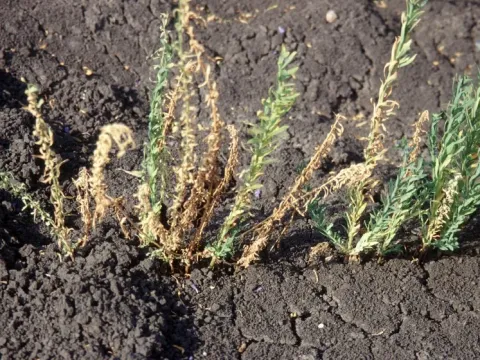
Early signs include a pale green discoloration of the foliage and a noticeable loss of turgor. Affected plants appear limp, eventually causing the stem tip to bend, often described as a shepherd's crook.
Root systems of infected plants are typically dark, decayed, and poorly developed. This root damage is a reliable indicator that the vascular system is compromised by the fungal mycelium.
Lower leaves may wither and turn yellow before eventually dropping. In humid conditions, a fine, pinkish or white fungal growth may become visible near the base of the stem.
Cross-sections of the lower stem reveal browning or necrosis of the vascular bundles. This tissue darkening confirms the obstruction caused by the colonization of the fungus.
- Loss of turgor and wilting of the stem tip.
- Chlorosis and premature yellowing of leaves.
- Root browning and localized decay.
- Vascular browning inside the stem.
- Premature death of isolated plants or entire patches.
Long-term crop rotation is the most effective management strategy. Implementing a gap of at least 6 to 7 years between flax crops helps reduce soil inoculum levels significantly.
Seed treatment with professional-grade systemic fungicides is essential to protect young seedlings. This prevents the initial colonization of the root system during the germination phase.
Good soil management, including effective drainage and avoiding soil compaction, creates an environment less conducive to fungal proliferation.
Utilizing resistant or tolerant flax varieties is the primary goal of modern breeding programs. These varieties are selected specifically to withstand local races of the pathogen.
During the growing season, if the infection is spotted early, localized fungicide applications may help to slow the spread of the fungus to surrounding healthy plants.