
Fusarium wilt pathogen complex
Complex of
Description
How to identify
The Fusarium wilt complex is caused by various species of the fungus Fusarium, with Fusarium oxysporum being the most prominent. These are filamentous fungi classified within the kingdom Fungi, phylum Ascomycota.
These pathogens are highly persistent soil inhabitants. They produce resilient resting structures, such as chlamydospores, which allow them to survive in the soil for several years even in the absence of a host plant.
The fungus infects plants primarily through the root system. Once inside, it colonizes the xylem tissue, which effectively creates a mechanical and chemical blockage that prevents water and nutrient transport.
Systematically, these fungi fall under the order Hypocreales and family Nectriaceae. They are known for their ability to secrete specialized phytotoxins that degrade plant health and accelerate the wilting process.
Morphologically, they are identified by the production of microconidia and macroconidia, which are responsible for rapid dissemination across fields during the growing season.
What it damages
Fusarium wilt affects a vast range of economically important crops, including tomatoes, cucumbers, cotton, bananas, and various leguminous and cereal plants.
The damage is devastating, often leading to total loss of the crop within the infected area. As the plant's vascular system collapses, the organism dies rapidly due to systemic water deficit.
Beyond yield loss, the infection results in poor quality products, including contaminated seeds that can carry the disease to new regions or future seasons.
In addition to direct plant death, the accumulation of mycotoxins in the harvested product poses significant health risks to both humans and livestock consumption.
The persistent nature of the fungus in the soil renders infested land unsuitable for growing susceptible cultivars for many years, requiring extensive soil remediation.
When it appears
The development of Fusarium wilt is highly dependent on environmental conditions, typically peaking during periods of warm soil temperatures ranging from 20°C to 28°C.
Infection cycles often start early in the spring, as the fungus penetrates newly germinated seedlings, which may result in pre-emergence or post-emergence damping-off.
During the peak of summer, when transpiration demands are high, infected plants show the most severe symptoms, as the compromised xylem cannot meet the water requirements.
Dispersal primarily occurs through infested soil particles, water runoff, contaminated farm machinery, and the use of infected vegetative propagation material.
As the season ends, the fungus shifts its metabolic activity to survive the winter, forming dormant structures in the soil or decaying plant tissues to survive low temperatures.
Signs of infestation
Symptoms typically begin with the yellowing (chlorosis) of the lower leaves, often on only one side of the plant or leaf, which progresses upward as the infection spreads.
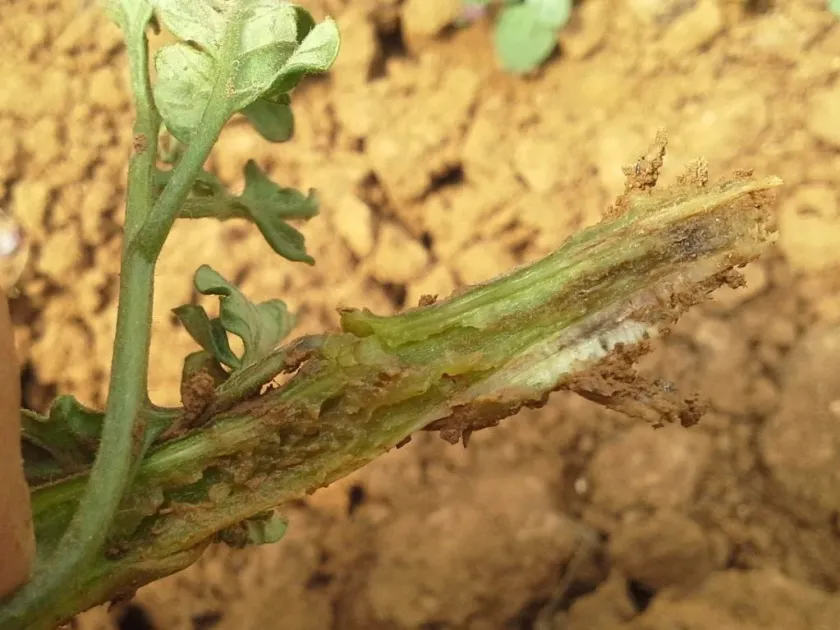
A diagnostic internal sign is the distinct browning or darkening of the vascular tissue (the vascular ring) when the stem or crown of the plant is sliced longitudinally.
In highly humid environments, mycelial growth may appear on the surface of stems near the base, often presenting as a white, pink, or orange fuzzy coating.
Plants often exhibit stunted growth, and in severe cases, the entire plant wilts permanently and dies, even if the soil remains moist.
- Progressive chlorosis and permanent wilting.
- Browning of the internal vascular system.
- Stunted plant growth and reduced vigor.
- Root rot symptoms and decay.
Control measures
Effective management begins with strict crop rotation, ensuring a gap of several years between planting susceptible crops to reduce the pathogen population in the soil.
Using certified, disease-free seed and resistant cultivars is the most effective long-term strategy for managing the disease in fields with a history of infestation.
Maintaining soil pH at an optimal level and managing irrigation to avoid waterlogged conditions can help reduce the vulnerability of the crop to fungal colonization.
Proper sanitation of tools and equipment between fields is essential to prevent the spread of chlamydospores carried in soil particles.
While chemical control with systemic fungicides can provide some protection, it is most effective when used as a preventive measure in integrated pest management programs.
Causes diseases · 1
Discussion
No discussions yet — be the first.