
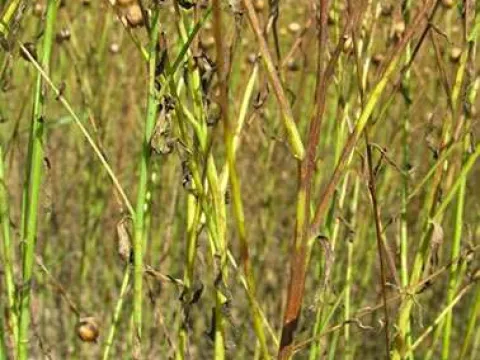
Flax seedling blight
Guignardia fulvida
The causal agent of this disease is the fungus Guignardia fulvida, belonging to the kingdom Fungi and the class Ascomycetes. It is a specialized phytopathogen that primarily targets flax plants.
What the section contains
Flax seedling blight
The fungus overwinters as mycelium and perithecia in infested soil and crop debris. When spring arrives, favorable moisture triggers the production of ascospores, which act as the primary inoculum for young seedlings.
The pathogen is particularly aggressive during the germination and early seedling stages. Infections typically begin through contact with contaminated soil particles or infected plant remnants left over from previous seasons.
The life cycle involves both asexual (pycnidial) and sexual (ascal) stages. During the growing season, conidia are dispersed by rain splashes and wind, facilitating secondary infections on healthy foliage and stems.
Microscopically, the fungus produces dark, submerged fruit bodies (pycnidia) within the host tissue, which are key diagnostic structures for identifying the presence of the pathogen.
The disease primarily affects flax crops, including fiber flax and oilseed flax. It causes damage to all aerial parts of the plant, including cotyledons, leaves, and stems.
Seedling blight is the most devastating manifestation, often leading to total stand loss. Infected seeds often fail to germinate, or resulting seedlings are stunted and lack the vigor required for development.
Infection disrupts the vascular system of the stem, interfering with the transport of nutrients and water. This results in wilt, weakened fibers, and a significant reduction in overall yield quantity and quality.
The economic impact can be severe, requiring growers to abandon or replant fields. Even when crops survive, the degradation of fiber quality makes the harvest less profitable for industrial processing.
High levels of infection can cause widespread damage, especially in regions with consistent spring rainfall that supports the rapid spread of the fungus among dense plant populations.
The pathogen is most active during the early spring months, coinciding with the germination and early emergence of flax seedlings. Cool, wet weather conditions are ideal for the disease to flourish.
Secondary infections may continue into the budding stage, provided the environment remains humid. However, increasing temperatures in the summer usually inhibit the pathogen, forcing it into a dormant phase.
The seedling emergence period is critical, as young tissues are extremely vulnerable to infection. Prolonged wet conditions significantly increase the likelihood of disease outbreaks.
As the season progresses toward harvest and autumn, the fungus retreats into the crop residue, forming survival structures that allow it to persist in the soil until the next growing cycle.
Optimal development generally occurs at temperatures between 15°C and 20°C. Fluctuations outside this range may slow down the infection rate, but the pathogen remains viable for future cycles.
The first signs of infection appear as yellowish or light-brown spots on the cotyledons. As the disease progresses, these spots expand, darken, and become studded with minute black pycnidia.
Stem girdling is a characteristic symptom. These lesions create weak points, leading to the bending, lodging, or snapping of the stems during wind or heavy rain events.
Leaves exhibit necrotic spots with dark margins, leading to premature yellowing and dropping. In severe cases, the entire growing point of the plant may die, resulting in stunted or dead seedlings.
Seedlings affected early in their development may appear rotten, and many fail to emerge from the soil entirely. Those that do emerge often display distorted, brownish growing tips.
Under high humidity, a subtle gray or white fungal sporulation may be visible on the stems, indicating that the pathogen is actively producing spores to spread further throughout the field.
Crop rotation is the most effective cultural practice. Growing flax in the same field should be avoided for at least 5 to 7 years to allow the soil-borne inoculum levels to decline naturally.
Using high-quality, disease-free, and certified seeds is essential. Seed treatment with appropriate fungicides is a mandatory prophylactic step to protect seedlings from early-season blight.
Post-harvest management is crucial; deep plowing of crop residues helps bury infected material, accelerating decomposition and reducing the pathogen's primary overwintering sites.
Proper plant density management helps improve airflow around the stems, reducing the humidity levels that favor fungal growth. Adequate spacing is a key factor in disease prevention.
If the disease is detected early in the growing season, the application of registered fungicides can effectively curb the spread and protect the crop yield until the plant reaches a more resistant stage.