
Flag smut of wheat
Urocystis tritici
Flag smut is caused by the microscopic fungus Urocystis tritici, which belongs to the kingdom Fungi. It is an obligate parasite specifically targeting wheat plants.
What the section contains
Flag smut of wheat
The life cycle begins with the infection of seedlings by spores located in the soil. These teliospores can remain viable for several years, making soil a significant reservoir for the pathogen.
Upon germination, the fungus penetrates the coleoptile of the seedling. It then colonizes the plant tissue, growing systemically through the intercellular spaces.
The fungus develops internally without causing visible symptoms until the plant enters the reproductive stage, at which point the pathogen begins massive spore production.
Dissemination occurs via contaminated seeds, where spores are attached to the surface, and through movement of infested soil by farm equipment or wind.
This disease exclusively affects wheat, causing severe stunting and deformation of infected plants. Infected wheat often fails to head properly or produces no grain at all.
The plants exhibit excessive tillering and shortened internodes. Often, the stems remain twisted and fail to emerge from the leaf sheaths, resulting in total yield loss.
When grain is produced, it is usually shriveled and contaminated with fungal spores, rendering it unsuitable for milling and lowering its market value significantly.
In fields with high infection rates, the wheat stand becomes thin and uneven, providing an opportunity for competitive weed growth that further reduces yield.
Economic damage is substantial, not only due to direct crop loss but also because infected grain poses challenges during harvesting and processing stages.
Infection is most favorable when soil temperatures are between 5°C and 20°C and moisture is moderate at the time of seed germination.
The pathogen remains hidden throughout the vegetative growth period. Symptoms become diagnostic as the plant reaches the jointing stage and approaches heading.
Environmental conditions that prolong seedling emergence can increase the window of vulnerability, leading to higher rates of infection in the field.
Spore maturation typically coincides with the wheat ripening phase. As the plant tissues dry, the epidermis ruptures, releasing millions of teliospores.
These spores disperse into the soil and onto the surfaces of healthy grains, resetting the infection cycle for the subsequent planting season.
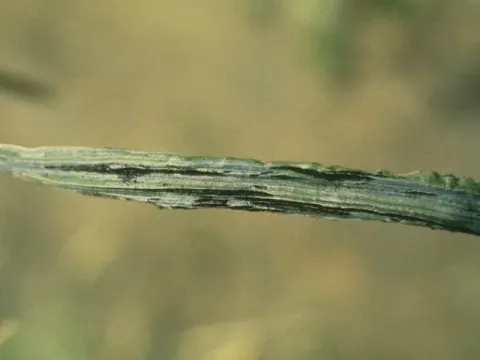
The primary symptom is the appearance of long, parallel stripes on leaves, leaf sheaths, and stems. These stripes are initially covered by the epidermis.
As the spores mature, the epidermal tissue ruptures, revealing characteristic black, powdery masses of teliospores, which is the most prominent diagnostic feature.
Infected plants are noticeably stunted with distorted, twisted leaves and stems. The overall architecture of the plant is altered compared to healthy individuals.
Heads (spikes) are often poorly developed or completely absent, frequently trapped within the upper leaf sheath and replaced by masses of fungal spores.
When inspecting a field, the presence of these dark, soot-like stripes on the foliage during the late vegetative stage is a clear indicator of a flag smut outbreak.
Effective management requires an integrated approach that combines cultural practices with the judicious use of chemical seed treatments.
Using certified, disease-free seed is the first line of defense. Ensuring that seed has been properly cleaned is crucial for preventing the introduction of the pathogen to new areas.
Chemical seed treatments with systemic fungicides are highly effective at protecting the vulnerable seedling stage from both soil-borne and seed-borne inoculum.
Crop rotation is essential to reduce the concentration of spores in the soil. A gap of at least 3-4 years between wheat crops is generally recommended.
- Systemic seed treatment with fungicides.
- Crop rotation to minimize soil spore load.
- Use of resistant wheat cultivars.
- Proper soil preparation to facilitate uniform and rapid seedling emergence.