
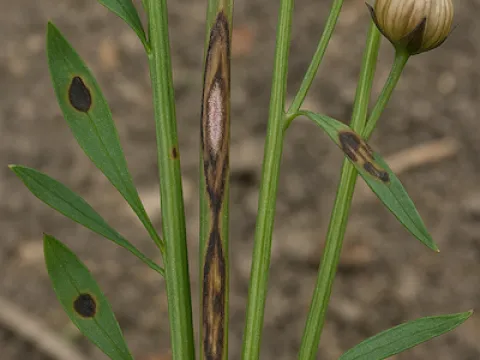
Flax anthracnose
Colletotrichum lini
Flax anthracnose is caused by the fungus Colletotrichum lini (syn. Colletotrichum linicola), which belongs to the order Melanconiales. This phytopathogen is highly specialized and poses a significant threat to flax cultivation globally.
What the section contains
Flax anthracnose
The fungus reproduces primarily through conidia, which are produced in small, cushion-like structures known as acervuli. These acervuli, often equipped with dark setae, develop beneath the plant epidermis and erupt to release spores.
The pathogen is primarily seed-borne, with mycelium persisting within the seeds. It can also survive on crop debris and in the soil, providing multiple pathways for the initiation of infection in subsequent growing seasons.
As a hemibiotrophic pathogen, Colletotrichum lini initially colonizes host tissues without immediate cell death, later switching to a necrotrophic phase that destroys plant tissue through the secretion of lytic enzymes.
Microscopic analysis is essential for accurate identification, as the presence of characteristic conidial masses with dark setae within the acervuli confirms the diagnosis of anthracnose in lab settings.
Anthracnose causes severe economic losses by affecting all plant parts including roots, stems, cotyledons, and capsules. It results in reduced plant density, lower fiber quality, and poor seed viability.
Seedling blight is a common result of early infection, often leading to total loss of germinating seeds and the need for field reseeding. Roots affected by the fungus exhibit rot, which stunts overall plant development.
Stem lesions interrupt the vascular system, preventing the proper flow of water and nutrients. This structural damage causes the stems to become weak and brittle, which is particularly detrimental for fiber flax production.
Infection of the capsules leads to the development of shriveled, poor-quality seeds. These seeds not only lack commercial value but also carry the fungus into the next planting cycle.
Secondary infections of the foliage and stems further decrease the photosynthetic capacity of the plant, leading to premature senescence and a significant reduction in the final crop yield.
Infection cycles begin at germination when the pathogen transfers from the seed to the emerging seedling. High soil moisture and moderate temperatures create favorable conditions for initial seedling colonization.
Throughout the growing season, conidia are dispersed by rain splashes, wind, and insects to healthy tissues of the same or neighboring plants, facilitating secondary infection cycles.
The disease thrives in conditions of high relative humidity (above 85%) and temperatures ranging from 18 to 22 degrees Celsius. Warm, humid weather is particularly conducive to rapid disease progression.
The flowering and capsule maturation stages are critical, as the fungus actively colonizes reproductive organs during these periods, creating a reservoir of inoculum for future harvests.
The fungus survives winter dormant as mycelium within infected seeds or as structures on crop residue. This persistence necessitates integrated management strategies to break the infection cycle every year.
Early symptoms appear on cotyledons as yellow spots that eventually turn brown. Under high humidity, a pinkish or orange mass of conidia may be visible on the surface of these spots.
Stem lesions manifest as elongated brown or black streaks that eventually develop into depressed, necrotic ulcers. These ulcers can encircle the stem, leading to lodging and breakage.
Capsule symptoms include blackened, sunken spots that signify deeper colonization of the tissue. If infection is severe, the entire capsule may rot, and the seeds within become discolored and malformed.
Plants affected by root rot exhibit systemic chlorosis, stunting, and an overall lack of vigor. Field patches of thin, yellowing, or dead plants are clear indicators of a localized anthracnose outbreak.
- Yellowing and browning of cotyledons.
- Sunken, necrotic stem lesions.
- Pinkish conidial masses on infected tissue.
- Blackened and malformed capsules.
- Premature wilting and plant stunting.
The primary control measure is the use of high-quality, disease-free seed. All seeds should be subjected to laboratory testing to ensure they are free of Colletotrichum lini.
Seed treatment with systemic fungicides is mandatory to eliminate both surface-borne and internally-borne inoculum. Proper chemical selection ensures better germination and early seedling protection.
A well-planned crop rotation is vital. A break of 5–7 years between flax crops allows for the natural degradation of fungal inoculum in the soil, effectively reducing the risk of re-infection.
Good agronomic practices, such as plowing under crop debris immediately after harvest and maintaining optimal planting density, help create a less favorable environment for disease development.
Foliar fungicide applications during the vegetative stage can be effective in regions with high disease pressure, especially when weather conditions favor rapid spore dispersion and infection.