
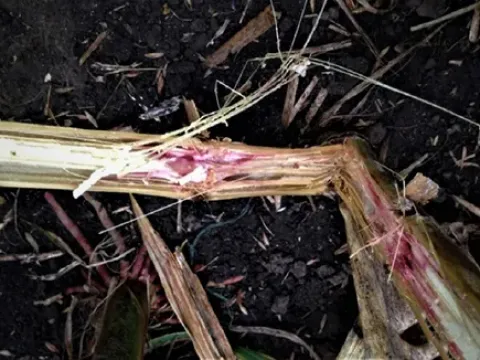
Gibberella zeae
Gibberella zeae
Gibberella zeae, known in its anamorph form as Fusarium graminearum, is a notorious ascomycetous fungus within the Nectriaceae family. It is recognized globally as the primary pathogen causing Fusarium head blight (FHB) in cereal crops.
What the section contains
Gibberella zeae
This fungus is a member of the kingdom Fungi, phylum Ascomycota. It survives in agricultural fields on infected crop residues, producing perithecia that release ascospores to initiate infections during the growing season.
The pathogen is highly aggressive, utilizing both sexual and asexual reproduction cycles to ensure survival. Its mycelium spreads through vascular tissues, severely impacting plant health and yield quality.
A major concern regarding this pathogen is its ability to produce potent mycotoxins, including deoxynivalenol (DON) and zearalenone. These toxins pose significant health risks to humans and livestock, leading to massive financial losses in the food industry.
The fungus is classified as a hemibiotroph, initially colonizing living host tissues before switching to a saprotrophic lifestyle on dead or dying organic matter.
The primary hosts of Gibberella zeae include wheat, barley, rye, and oats. In these crops, it causes Fusarium head blight, which significantly reduces grain weight and seed quality.
Maize is also a primary target, where the fungus causes ear rot. This leads to the decay of kernels and can cause entire ears to become covered in fungal growth, making the crop unfit for commercial use.
In addition to grain yield losses, the pathogen can infect roots and stem bases, contributing to premature senescence and plant lodging, especially under high-wind conditions.
The infection disrupts the plant's ability to transport nutrients, leading to shriveled, discolored grains that have poor germination rates and reduced nutritional value.
Spread is facilitated by wind-borne spores, which can travel across vast distances, making it difficult to contain outbreaks if the weather conditions are favorable for the fungus.
The most critical window for infection is during the flowering (anthesis) phase of cereals. During this stage, the fungus exploits the exposed anthers as a primary entry point into the developing head.
Warm, humid conditions are the primary drivers of Gibberella zeae development. High relative humidity (exceeding 85%) during anthesis significantly increases the severity of head blight.
Primary inoculum, in the form of ascospores, is typically discharged from perithecia on crop debris when soil temperatures rise above 10-12°C in the spring, coinciding with crop emergence.
The pathogen completes its life cycle by producing both ascospores and macroconidia, allowing it to adapt to various environmental conditions throughout the growing season.
If prolonged wet weather occurs during the pollination phase, the risk of an epidemic increases exponentially, even if the initial inoculum levels are relatively low.
The hallmark symptom of Fusarium head blight on wheat is the premature bleaching of spikelets. In humid conditions, a characteristic pink or salmon-colored fungal growth (mycelium) often appears at the base of the glumes.
On maize, the presence of the fungus is signaled by a white or pinkish fluffy mycelium covering the ears. Kernels under the fungal mass may appear gray, brown, or completely rotted.
Infected plants often show necrotic, brownish lesions on the stem bases or roots, indicating that the fungus has spread from the soil and inhibited water uptake.
The grains within the infected head are typically shriveled and lightweight. In some cases, they may show signs of discoloration, often referred to as "tombstone" grains due to their shrunken, brittle appearance.
- Premature bleaching of individual spikelets.
- Pink or orange moldy growth on grain heads.
- Shriveled, lightweight, and discolored kernels.
- Dark necrotic lesions on the root and stem base.
Integrated pest management (IPM) is essential. Crop rotation is the most critical cultural practice; avoiding wheat or barley after maize reduces the carryover of inoculum on residues.
Tillage practices that incorporate crop debris deep into the soil help accelerate the decomposition of infected plant material, thereby reducing the amount of overwintering inoculum.
Fungicide application during the flowering stage is the most effective chemical measure. Triazole-based fungicides are standard for protecting the head from initial spore infection.
Breeding and planting resistant cultivars is a long-term solution. While complete immunity is rare, modern varieties with higher tolerance levels significantly reduce economic damage.
Seed treatments with systemic fungicides are recommended to prevent the spread of the pathogen via contaminated seeds and to protect emerging seedlings from early-season damping-off.