
Gibberella subglutinans
Gibberella subglutinans
Description
How to identify
Gibberella subglutinans (anamorph Fusarium subglutinans) is a fungal pathogen belonging to the Ascomycota phylum. It is a well-known agent causing severe diseases in maize and several other cereal crops globally.
The fungus produces asexual spores called microconidia and macroconidia, which are responsible for its rapid spread during the growing season. Under specific conditions, it can also produce sexual structures known as perithecia.
This pathogen has a high survival capability, persisting in crop residues, soil, and infected seed stocks. Its ability to remain dormant in the environment makes it a persistent challenge for modern agriculture.
Identification is primarily carried out through microscopic analysis of conidial morphology and growth patterns on selective media. Because it shares phenotypic similarities with other Fusarium species, precise molecular diagnostics are often required.
The fungus thrives in diverse ecological niches, adapting its development cycles to the specific host plant and local environmental conditions, which explains its wide geographical distribution.
What it damages
The primary impact of Gibberella subglutinans is observed in maize, where it causes ear rot, stalk rot, and seedling blight. It can also infect other grasses, including wheat and sorghum, causing similar decay symptoms.
Infection often occurs through silk colonization during flowering or via wounds caused by insect feeding. Seed-borne infection is another critical pathway, leading to poor crop establishment and systemic disease development.
The economic damage is twofold: a direct reduction in grain yield due to kernel destruction, and the accumulation of mycotoxins like fumonisins. Contaminated grain often fails to meet safety standards for food and feed.
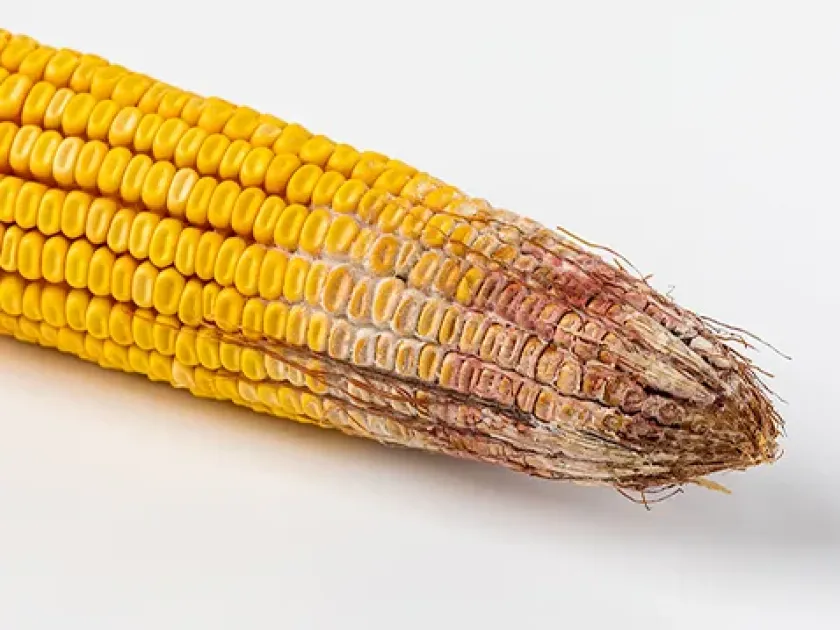
Affected ears exhibit white to pinkish fungal growth that penetrates the kernels, leading to their degradation. In severe cases, the entire ear may become mummified or rotten before harvest.
Stalk rot infections weaken the plant structure, leading to lodging, which significantly complicates harvesting processes and increases field losses during the late stages of crop development.
Signs of infestation
The most visible symptom on maize ears is the development of a white to salmon-pink mycelial mat. This fungal growth often starts at the ear tip and can spread to cover the entire cob if weather conditions remain humid.
Seedling blight manifests as poor emergence and stunted growth. Young plants often display brown, necrotic lesions on their roots and mesocotyls, which can lead to seedling death if the infection is systemic.
Stalk rot appears as internal discoloration of the stem, where the pith becomes disintegrated and discolored. This internal rot restricts water and nutrient transport, leading to premature plant wilting and senescence.
Kernels infected by the pathogen appear discolored, shriveled, and may show small white fungal tufts. These grains have significantly reduced germination rates and serve as the primary source for disease transmission in the next cycle.
- White to pinkish fungal growth on maize ears.
- Brown, rotting lesions on the root and stem base.
- Premature yellowing and drying of the plant.
- Poor grain fill and reduced kernel weight.
Control measures
Integrated pest management (IPM) is the most effective approach. Crop rotation is essential to break the survival cycle of the fungus, ensuring that host crops are not planted back-to-back in the same field.
Tillage practices that incorporate crop residues deep into the soil facilitate the decomposition of the plant matter, effectively reducing the inoculum load available for the next growing season.
Seed treatment with systemic fungicides is a standard and critical procedure to protect emerging seedlings from both soil-borne and seed-borne infection, ensuring a uniform and healthy plant stand.
Controlling insect pests, such as the European corn borer, is vital. By minimizing physical injury to the plants, the chances of the fungus entering the ear and causing infection are greatly reduced.
Selecting and planting resistant or tolerant hybrids is a long-term strategy for managing the disease. Farmers should prioritize varieties that demonstrate robustness against ear rot and stalk rot under local environmental pressures.
Causes diseases · 1
Discussion
No discussions yet — be the first.