
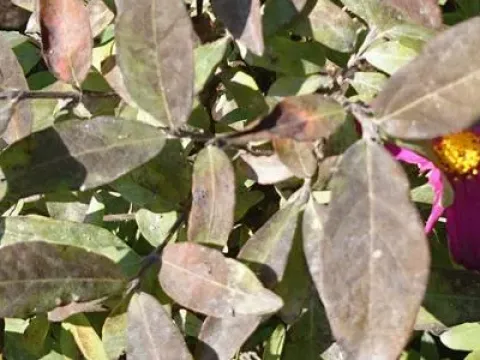
Sooty mold
Fumago vagans
Sooty mold (Fumago vagans) is a saprophytic fungus that belongs to the Capnodiaceae family. It is not a primary parasite of plants.
What the section contains
Sooty mold
The fungus develops as a surface coating of dark, filamentous mycelium that resembles a layer of soot or black dust.
The organism feeds on honeydew, which is the sugary liquid excreted by piercing-sucking insects like aphids, scales, and whiteflies.
Taxonomically, it is categorized as an epiphytic fungus that colonizes surfaces rich in organic carbon sources, such as sugar-rich honeydew.
It remains entirely on the surface of the plant, without invading internal tissues, but it creates significant physiological stress for the host plant.
Sooty mold affects a wide range of agricultural crops, trees, shrubs, and ornamental houseplants across the globe.
The mold forms a dense film on leaves and fruits, effectively blocking sunlight and severely inhibiting the process of photosynthesis.
In addition to blocking light, the layer can clog the leaf stomata, reducing the plant's ability to undergo gas exchange and respiration.
Affected fruit often loses its aesthetic value and becomes unsellable due to the persistent black stains that are difficult to clean off.
While the plant is not structurally damaged, prolonged infestation results in slowed growth, leaf yellowing, and overall decline in vigor.
Sooty mold is most prevalent during warm, humid seasons when populations of honeydew-producing insects are at their peak.
It typically appears during late spring, throughout the summer, and into the early autumn, coinciding with the active cycles of pest infestations.
The development is favored by stagnant air conditions and low light, which often occur within dense, unpruned tree canopies.
Spores of the fungus are spread easily by wind, rain, and moving insects, allowing for rapid colonization of healthy plant tissue.
The fungal development slows down significantly in dry, cool conditions, but the existing black layer may persist on leaves until they drop.
The most distinctive sign is a sticky, shiny substance on leaves, followed by the rapid development of a black, velvet-like fungal mat.
Visible presence of aphids, scale insects, or whiteflies on the undersides of leaves is a primary indicator of an imminent mold outbreak.
- Black, powdery coating that can be rubbed off with a finger.
- Sticky residue (honeydew) on foliage, stems, and even on the ground below the plant.
- Yellowing and premature abscission of leaves due to insufficient light.
- Stunted shoot growth and poor fruit development.
- Presence of ants, which are often attracted to the honeydew.
Visual identification is straightforward because the fungus does not cause localized necrotic spots or structural tissue decay.
The primary control strategy is the management and eradication of the insects that produce honeydew, such as aphids and scale insects.
Regular monitoring of plants allows for early detection of pest colonies, enabling the application of targeted systemic insecticides.
Cultural practices, such as proper pruning and thinning of branches, improve airflow and light penetration, making the environment less favorable for the mold.
Once the pest population is under control, the sooty mold layer can be removed by washing the plant with a mild detergent or soapy water.
In severe cases, copper-based fungicides can be applied to sterilize the surface and prevent further colonization by fungal spores.