
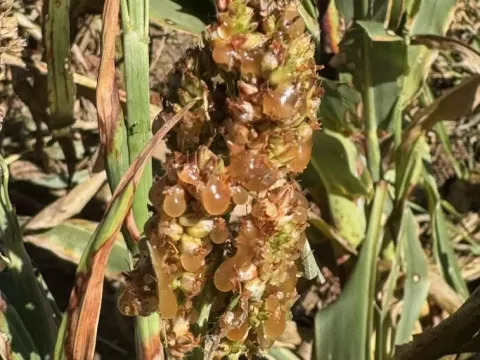
Sorghum ergot
Claviceps africana
The causative agent of sorghum ergot, Claviceps africana, belongs to the kingdom Fungi, phylum Ascomycota, class Sordariomycetes, order Hypocreales, and family Clavicipitaceae. It is a highly specialized plant pathogenic fungus.
What the section contains
Sorghum ergot
Unlike classic rye ergot, this species induces "sticky" ergot, characterized by the abundant secretion of honeydew. The fungus exclusively infects the generative organs of the plant during the flowering stage.
The life cycle includes a conidial stage (sphacelia), which spreads actively via insects and wind under humid conditions. Later, sclerotia form—dormant structures containing nutrient reserves essential for the fungus's survival.
This species is a typical pathogen that has evolved in close association with its hosts within the Sorghum genus. Its prevalence is directly linked to the geographical distribution of sorghum cultivation.
The fungus can persist in the soil or as contaminants in seed lots, making it a significant threat to both commercial production fields and seed multiplication programs.
The primary hosts are grain sorghum and sweet sorghum. The fungus infects unfertilized ovaries of the host plant, completely replacing the grain tissue with its fungal mycelium.
As a result of the infection, a sclerotium (ergot) forms in the floret instead of a normal grain. This is a hard, dark-brown to black structure that protrudes beyond the glumes.
The infection causes substantial yield losses, as infected panicles become largely sterile. Both the total grain weight and the quality of the harvested product are significantly reduced.
Additional damage occurs through the contamination of the grain mass with sclerotia, which contain toxic alkaloids. Feeding such contaminated grain to livestock can lead to serious health issues.
In heavily infested fields, reduced seed germination and deformed panicle development are frequently observed, which is critical for breeding and seed production sectors.
The critical period for infection is the flowering stage of the sorghum plant. Spores must land on the stigma before successful fertilization occurs to establish an infection.
Disease outbreaks are most frequent during cool and humid weather patterns during the flowering phase. Temperatures between 20–25°C are optimal for the rapid germination of conidia.
High relative humidity (above 80%) promotes the secretion of honeydew—a sticky fluid containing millions of conidia that are disseminated across the field.
The period of infection spread is prolonged because sorghum panicles flower gradually, allowing the fungus an extended window of time to colonize new florets.
By the end of the growing season, as the crop matures, the conidial development slows down, and the fungus transitions into the formation of hard, dormant sclerotia.
The first visible symptom is the appearance of sticky, viscous droplets of "honeydew" leaking from infected florets early in the infection process.
This liquid eventually runs down the stalks and leaves, providing a medium for saprophytic fungi to grow, which often leaves the plant surface covered in a black, sooty mold.
Inside the glumes, instead of a healthy grain, one can find a whitish or creamy mycelial mass, which eventually darkens and hardens into a mature structure.
At later stages, elongated sclerotia clearly protrude from the glumes and are easily visible upon inspection of the panicle. They typically have a characteristic shape, often longer and thinner than normal seeds.
When shaking the panicles, infected parts may shed easily, and a sticky residue on the hands or clothing remains, serving as a clear indicator of active sporulation.
The primary control measure is the use of high-quality seed material that has been thoroughly cleaned to remove all sclerotia. Seed cleaning equipment can effectively separate these fungal bodies.
Important agronomic practices include maintaining spatial isolation between fields and adhering to strict crop rotation schedules. Avoid planting sorghum in fields that experienced high disease pressure in previous seasons.
Managing planting dates allows growers to avoid having the critical flowering stage of the crop coincide with weather conditions that are highly favorable for fungal spore dispersal.
Controlling wild sorghum weeds near field borders reduces the inoculum reservoir, as these grasses can harbor the pathogen throughout the growing season.
Chemical control involving fungicides applied during flowering is an option, although its effectiveness is often limited by the technical difficulty of ensuring the product reaches the florets.