
Soil-borne wheat mosaic virus
Soil-borne wheat
The causative agent of the disease is the Soil-borne wheat mosaic virus (SBWMV), a member of the Furovirus genus. It is an RNA virus that primarily infects winter cereal crops.
What the section contains
Soil-borne wheat mosaic virus
The main vector and reservoir of the virus in the soil is the obligate parasite Polymyxa graminis, a plasmodiophorid organism. The virus persists in its resting spores (cystosori) for many years.
Transmission occurs when the zoospores of the vector infect the roots of wheat seedlings. Infection is dependent on specific environmental conditions favorable to the vector.
The virus is classified as a soil-borne pathogen capable of surviving in deep soil layers, making it extremely difficult to eradicate from agricultural fields.
Spread across fields occurs through contaminated soil movement, farm machinery, and surface water runoff during irrigation or heavy rains.
SBWMV affects winter wheat, winter barley, rye, and various wild grasses. The disease causes significant economic losses, reducing grain yield by up to 30% or more.
Infection happens at early growth stages when the virus enters the root system. The pathogen disrupts essential physiological processes like photosynthesis and metabolism.
Severe infections lead to stunted growth, reduced tillering, and poor development of the crown, which can sometimes result in total crop failure in spring.
The overall impact includes reduced grain quality, lower thousand-kernel weight, and decreased density of productive stems per hectare.
The severity of the damage is highly dependent on the resistance of the wheat variety to specific strains of the virus present in the area.
Initial symptoms become visible in early spring immediately after the winter wheat resumes growth. Conditions like cool, wet autumns are optimal for infection.
Viral development inside the plant accelerates at soil temperatures between 10 and 15 degrees Celsius. The vector Polymyxa graminis is most active during moist periods.
As temperatures rise in late spring and summer, symptoms on new leaves may fade, although the plant remains systemically infected until maturity.
The virus life cycle is closely synchronized with its vector, which infects roots during the autumn, setting the stage for spring epidemics.
In fields, the disease often occurs in low-lying areas where moisture is retained longer, providing ideal conditions for zoospore movement.
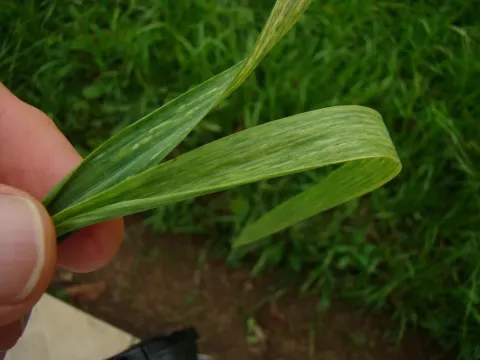
The primary symptom is a mosaic pattern on leaves, appearing as light green or bright yellow streaks, patches, and stripes parallel to the leaf veins.
Affected plants exhibit noticeable stunting and a general sickly appearance, showing significantly less vigor compared to healthy neighbors.
As the disease progresses, the leaves may turn completely yellow, curl, and die prematurely, starting from the lower leaves upwards.
Field observation shows patches of discolored, stunted plants that contrast sharply with the surrounding healthy canopy.
- Bright yellow-green leaf mosaic.
- Significant stunted growth and poor tillering.
- Rosetting or shortening of internodes in severe cases.
The primary method of control is the use of wheat cultivars that have been bred for genetic resistance to the specific strains of the soil-borne mosaic virus.
Effective crop rotation practices help reduce the population of the vector Polymyxa graminis, as a break of several years restricts the virus reservoir.
Agronomic strategies include adjusting planting dates; sowing later, when soil temperatures have dropped, can significantly lower the risk of initial root infection.
Improving field drainage is critical, as waterlogged areas are hotspots for the proliferation of the vector and the subsequent spread of the virus.
Chemical control of the vector using soil fungicides is generally cost-prohibitive and ineffective, focusing efforts instead on resistant genetics and monitoring.