
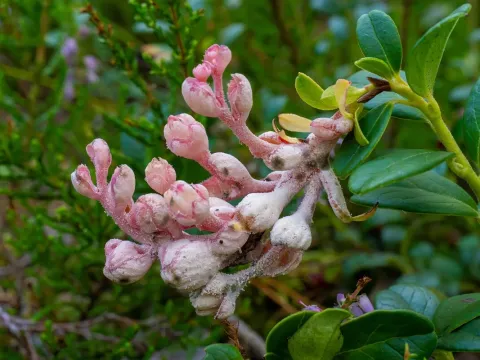
Blueberry Exobasidium leaf gall
Exobasidium vaccinii-uliginosi
The causative agent of the disease is the fungus Exobasidium vaccinii-uliginosi, which belongs to the division Basidiomycota. It is a highly specialized phytopathogen that targets members of the Ericaceae family.
What the section contains
Blueberry Exobasidium leaf gall
The fungus mycelium develops internally within the host plant tissues, spreading through the intercellular spaces to extract nutrients.
The pathogen is an obligate parasite, meaning its entire life cycle is intricately linked to the developmental stages of the blueberry shrub.
The life cycle involves the formation of basidia directly on the surface of infected plant organs during the sporulation period. Spores are dispersed by wind, water splashes, and insects.
The fungus overwinters as dormant mycelium inside the buds and young shoots of the plant, ensuring its survival against harsh seasonal conditions.
The main hosts for this fungus are wild blueberries and various commercial cultivars. The disease causes significant economic loss by affecting both yield and plant health.
The pathogen targets leaves, young succulent shoots, and occasionally fruit ovaries. Affected organs lose their structural integrity and physiological function.
Shoots infected by the fungus exhibit hypertrophy and swelling, which disrupt the vascular system and water transport, causing the stems to weaken.
The overall photosynthetic capacity of the plant is reduced, leading to lower fruit quality, stunted berry size, and a significant decrease in total harvest.
In nurseries, the disease is particularly dangerous as it can spread rapidly through stocks, compromising the quality of seedlings before they are planted.
Primary symptoms usually appear in early spring, shortly after bud break and during the onset of active shoot elongation.
Optimal conditions for pathogen activity include high humidity and moderate temperatures, which are common during the first half of the growing season.
Prolonged rainy weather provides the necessary moisture for the rapid germination of basidiospores on the leaf surfaces, leading to infection outbreaks.
Hot and dry weather significantly inhibits the growth and spread of the fungus, suppressing the development of the characteristic fungal bloom on leaves.
By late summer, the fungus activity declines, and it transitions into its overwintering phase within the protected buds of the host plant.
The most distinctive symptom is the appearance of light, white to pinkish spots on the leaves, which eventually become thickened and swollen.
On the underside of the leaves, a dense, velvety layer of fungal sporulation, known as the hymenophore, forms in the affected areas.
Infected shoots show severe hypertrophy, becoming thick, fleshy, and often discolored with reddish or yellow hues compared to healthy growth.
In advanced cases, the infected leaves curl, dry out, and drop prematurely, leaving branches partially defoliated during the peak season.
When ovaries are infected, the developing berries become deformed, show abnormal swelling, and typically fall off before they can ripen.
The primary control strategy involves cultural practices, specifically the regular removal and destruction of all symptomatic shoots and leaves.
Proper spacing and canopy management are crucial to promote airflow and reduce local humidity, which prevents the fungus from establishing on foliage.
Chemical control includes the application of copper-based fungicides early in the spring, before the onset of new vegetative growth.
Systemic fungicides belonging to the triazole or strobilurin classes can be used during the growing season if early symptoms are detected.
- Strict sanitation and tool disinfection
- Selection of resistant blueberry varieties
- Monitoring environmental conditions to time fungicide applications