
Blackleg of brassicas
Leptosphaeria maculans
The causative agent of blackleg disease is the ascomycete fungus Leptosphaeria maculans (anamorph Phoma lingam), belonging to the class Dothideomycetes. This significant phytopathogen affects a wide range of crops within the Brassicaceae family, causing dry rot of stems and root necks.
What the section contains
Blackleg of brassicas
The fungus's life cycle involves a sexual stage (pseudothecia on plant debris) and an asexual stage (pycnidia), which facilitates the spread of conidia throughout the growing season. Infection remains in the soil on stubble and infected seeds for up to three or four years.
Disease progression is closely linked to environmental factors: optimal temperatures for infection are +15...+20°C, accompanied by high air humidity and frequent rainfall. Fungal spores are dispersed by wind from primary infection sources to surrounding fields.
The pathogen enters plant tissues through stomata, mechanical wounds, or natural cracks caused by root growth. The fungal mycelium progressively colonizes the vascular system, causing necrotic lesions that inhibit nutrient transport and overall plant health.
Accurate diagnosis requires phytopathological analysis of plant samples, which allows for isolating the fungal culture on specialized media or identifying characteristic pycnidia and conidia through microscopic examination.
Blackleg affects almost all agricultural and wild Brassicaceae species, with winter and spring canola, mustard, and cabbage being the most susceptible crops.
The economic damage manifests as reduced stand density, premature lodging of the crop before harvest, and shattering of siliques (pods), leading to significant yield losses in seed production.
Infection of the root neck disrupts tissue conductivity, causing wilting and plant death, particularly during autumn development or after harsh overwintering conditions.
Beyond reduction in thousand-seed weight, the disease negatively impacts seed quality, including oil content, which is vital for the processing industry.
In severe epiphytotic conditions, yield losses in canola fields can exceed 50 percent of the potential productive capacity.
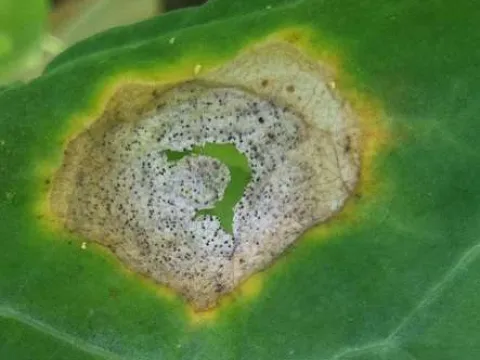
Early symptoms appear on cotyledons and leaves as circular greyish-brown spots containing numerous small black dots, known as pycnidia.
Necrotic, depressed lesions form on stems and the root neck, eventually turning grey with a distinctive dark border as the infection matures.
A hallmark symptom is dry rot of the root neck, where tissue disintegration creates cavities or hollows, making the plant brittle and susceptible to lodging.
Infected siliques show greyish depressed lesions that quickly become covered in pycnidia under humid weather conditions.
In the field, affected plants may appear chlorotic and stunted, with premature wilting of lower leaves, creating a noticeable contrast against the healthy crop canopy.
The primary control strategy involves crop rotation combined with spatial isolation, ensuring new brassica fields are at least 500 meters away from the previous year's infested fields.
Utilizing certified, fungicide-treated seed is the foundation of protecting crops during the critical early stages of development.
Agronomic management practices include deep burial of crop residues to accelerate their decomposition and interrupt the fungus's lifecycle within the soil environment.
Fungicide applications during the growing season, particularly during the 4–6 leaf stage and early flowering, are essential to suppress infection spread and protect stems from critical damage.
- Cultivation of resistant canola hybrids and varieties.
- Control of cruciferous weeds that serve as alternative infection reservoirs.
- Optimized fertilization programs to enhance the natural resistance of the crop.