
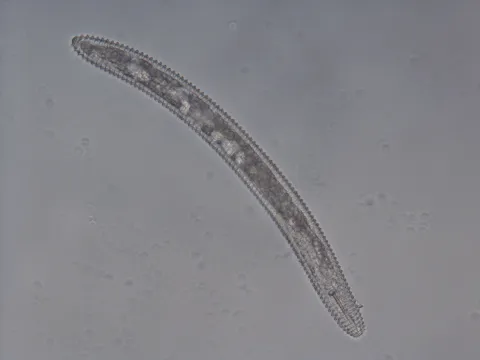
Ring nematode
Criconemoides xenoplax
The ring nematode, scientifically known as Criconemoides xenoplax, is a minute plant-parasitic organism belonging to the Criconematidae family. It is easily recognized under a microscope by the prominent, thick cuticular rings that cover its body, giving it a ring-like appearance.
What the section contains
Ring nematode
These nematodes possess a long, robust stylet designed to pierce root cells to extract nutrients. Adults are typically 0.4–0.6 mm in length. Due to their extremely small size, they cannot be seen with the naked eye, making field detection difficult without soil analysis.
The life cycle occurs entirely in the soil environment. Females deposit eggs near the roots of host plants. The development through four juvenile stages to the adult phase is highly dependent on soil moisture and temperature, typically thriving in sandy soil environments.
Identification in a diagnostic laboratory involves using soil extraction techniques such as the Baermann funnel or centrifugal flotation methods. These procedures allow specialists to count the number of nematodes and assess the potential risk to agricultural crops.
The ring nematode is a persistent inhabitant of the soil. It can survive for extended periods under harsh conditions, often persisting in the soil even after the removal of host plants, which makes it a challenging pest to eradicate completely from orchard sites.
Criconemoides xenoplax primarily targets woody perennials, causing significant damage to stone fruits such as peaches, plums, cherries, and almonds. Apples, vineyards, and various landscape plants are also susceptible to its feeding activities.
As the nematode feeds on root tissue, it causes cellular damage, necrosis, and the pruning of root hairs. This destruction of the root system limits the plant's ability to uptake water and essential minerals, leading to overall plant vigor decline.
This species is notorious for its role in the "replant disease" complex. By causing mechanical injury to roots, it facilitates the entry of other soil-borne pathogens, particularly Pseudomonas syringae, which leads to bacterial canker in fruit trees.
Heavy infestations result in stunted tree growth, thin canopies, and chlorotic leaves. Trees infected by these nematodes are significantly more vulnerable to environmental stresses, including drought, nutrient deficiencies, and extreme temperature fluctuations.
In commercial orchards, the presence of these nematodes often leads to a phenomenon known as "short-life" of trees, where orchards become unproductive much earlier than expected, forcing growers to invest in soil fumigation or costly replanting efforts.
One of the earliest visible indicators of ring nematode infestation is the chlorosis (yellowing) of foliage. Despite adequate fertilization, the tree remains pale due to the inability of the damaged root system to transport essential nutrients to the leaves.
When examining the root system, one may observe blackened, necrotic, and brittle root tips. The root architecture appears reduced and poorly developed compared to healthy trees, as the plant struggles to produce new, functional root tissue to replace the damaged one.
Above-ground symptoms include slow vegetative growth and shortened internodes. Fruit production is frequently reduced, and the remaining fruit may be small or of poor quality due to the tree's redirected energy towards survival rather than crop development.
In cases where the nematode has facilitated a bacterial infection, severe symptoms such as deep stem ulcers and excessive gumming (gummosis) appear on the trunk and major scaffold branches. This indicates a late-stage, systemic health crisis for the tree.
The damage pattern in an orchard is often patchy. One can identify infected zones where trees appear noticeably weaker or have died, while neighboring trees remain relatively healthy. This mosaic pattern is typical of soil-borne pathogens moving gradually across a site.
Pre-plant soil fumigation is the most effective method for managing ring nematode populations. Using professional soil fumigants creates a cleaner environment for young trees to establish a healthy root system, significantly reducing the initial infestation risk.
Cultural management is crucial. Selecting resistant or tolerant rootstocks is a highly recommended practice for planting in sandy soils known to harbor these nematodes, as these rootstocks can withstand higher nematode pressure without substantial loss of vigor.
Implementing cover crops with nematicidal properties, such as specific varieties of oilseed radish or mustard, can help suppress nematode populations. When incorporated into the soil as green manure, they release compounds that inhibit nematode development.
Maintaining optimal irrigation and soil nutrition helps trees mitigate the impact of nematode feeding. Healthy trees with adequate moisture levels are much better equipped to tolerate the presence of these parasites compared to trees suffering from environmental stress.
While chemical nematicides can be applied during the growing season in established orchards, their effectiveness is often limited. Therefore, an integrated approach combining biological control agents, crop rotation, and sound orchard management is the most sustainable strategy.