
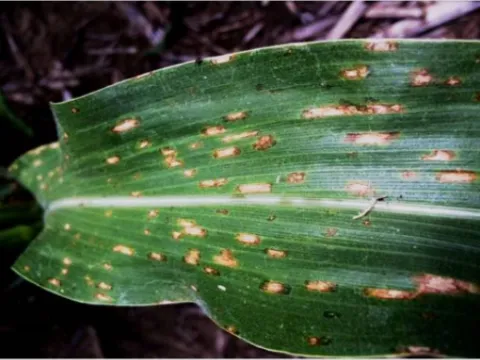
Cercospora leaf spot of maize
Cercospora zeina
The causal agent is the fungus Cercospora zeina, a member of the Ascomycetes class. This specialized phytopathogen is responsible for Gray Leaf Spot (GLS), a major foliage disease of maize.
What the section contains
Cercospora leaf spot of maize
The fungus survives the winter primarily in infected crop debris on the soil surface. During the growing season, wind and rain splash facilitate the dispersal of spores to healthy plant tissues.
Growth of the pathogen is favored by warm, humid conditions, specifically extended periods of leaf wetness and high relative humidity during mid-summer.
The fungal mycelium colonizes leaf tissues and emerges through the stomata to produce conidiophores, which generate new inoculum for secondary cycles of infection.
Understanding the microclimate within the canopy is crucial for predicting disease outbreaks, as denser canopies retain humidity longer, promoting rapid fungal proliferation.
The primary host is maize (Zea mays). While other grasses can occasionally serve as hosts, the economic impact is most severe in commercial corn production.
The disease reduces the photosynthetic capacity of the plant by killing leaf tissue, which directly correlates to reduced grain fill and lower yield potential.
Heavy infections lead to premature senescence of the entire plant, which significantly stresses the stalks and makes the crop susceptible to stalk rots and lodging.
When lodging occurs due to weakened stalks, harvesting becomes difficult, leading to substantial mechanical losses and potential contamination of grain.
Secondary effects include a reduction in grain quality and test weight, which can negatively impact the market value of the harvested crop.
Initial symptoms are characterized by small, indistinct, chlorotic spots that gradually develop into rectangular, tan or gray lesions delineated by the leaf veins.
A distinctive feature of Cercospora zeina is the appearance of a dark, velvety gray fungal sporulation on the underside of the leaf within the necrotic spots.
As the disease progresses, lesions coalesce and cover large areas of the leaf, causing the tissue to appear scorched or blighted from the bottom up.
The rigid, linear boundaries of the spots are a key diagnostic marker that distinguishes this disease from other common leaf blights like Northern Corn Leaf Blight.
- Small, rectangular, greyish-brown lesions.
- Delineation of lesions by secondary leaf veins.
- Velvety fungal sporulation on the underside of leaves.
- Blighted appearance of the foliage from lower to upper leaves.
Selecting hybrids with genetic resistance to Gray Leaf Spot is the most effective and sustainable long-term strategy for disease management.
Tillage practices that incorporate corn residues into the soil help accelerate the decomposition of infected matter, thereby reducing the amount of primary inoculum.
Crop rotation with non-host crops, such as soybeans or small grains, is essential to decrease the level of soil-borne inoculum over successive growing seasons.
Fungicide application during the early stages of disease development can be highly effective, particularly in environments with high disease pressure.
Integrated management should combine scouting, timely fungicide applications (such as strobilurins or triazoles), and the use of resistant maize germplasm.