
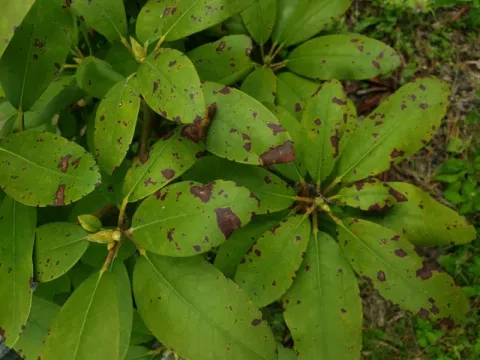
Cercospora leaf spot of rhododendron
Cercospora handelii
Cercospora leaf spot is a fungal disease caused by the pathogen Cercospora handelii. This fungus belongs to the phylum Ascomycota and typically manifests on evergreen rhododendron varieties as a foliage-damaging agent.
What the section contains
Cercospora leaf spot of rhododendron
The lifecycle of this pathogen involves survival as mycelium in old, fallen leaves throughout the winter. When temperatures rise and humidity levels increase, spores are produced and disseminated by rain splashes or wind to healthy leaf tissues.
The primary damage caused by Cercospora handelii is localized on the leaves. While the plant remains alive, severe infections can cause significant defoliation, which reduces the plant's aesthetic value and its overall vigor.
Plants kept in dense plantings with poor air circulation or those exposed to overhead irrigation during warmer months are at the highest risk. The stress caused by defoliation also makes the shrubs more susceptible to other biotic and abiotic stressors.
Infection begins as small, irregular reddish-brown spots on the upper leaf surface. As the disease progresses, these spots expand and often develop a grayish center with a distinct dark or purple-brown border.
- Circular to irregular leaf spots.
- Grayish center with dark halos.
- Dark fungal growth on the underside of the leaf.
- Premature leaf drop and yellowing.
The fungal sporulation, appearing as a fine, olive-gray fuzzy layer on the underside of the leaf, is a key diagnostic feature distinguishing this disease from other types of leaf spots.
Cultural management is the first line of defense. This includes removing and destroying all infected fallen leaves to reduce the primary inoculum source for the following season. Pruning for better air circulation is also highly effective.
Chemical control involves the application of fungicides, specifically copper-based products or systemic triazole fungicides. Applications should be performed preventively during the spring and early summer months, ensuring that the underside of the foliage is thoroughly covered.