
Cercospora leaf spot of beet
Beet leaf
Description
How to identify
Cercospora leaf spot is caused by the fungus Cercospora beticola, which is a member of the Ascomycota phylum. It is one of the most destructive foliar diseases affecting sugar beets and related species worldwide.
The pathogen overwinters primarily as stroma within infected plant debris remaining in the soil. Under favorable conditions in the spring, the fungus produces conidia which serve as the primary inoculum for new infections.
Dissemination of conidia occurs mainly via wind and rain splashes, allowing the pathogen to move from debris or weed hosts to the developing beet canopy. The disease develops rapidly during periods of high humidity and warm temperatures.
The fungus is highly specialized to the beet crop. It requires a specific microclimate within the canopy, typically characterized by high nocturnal humidity and temperatures between 20°C and 25°C for optimal colonization.
Microscopically, the pathogen is identified by the presence of dense tufts of conidiophores protruding through the leaf stomata. These structures release thousands of conidia, ensuring the rapid spread of the disease.
What it damages
The primary impact of Cercospora leaf spot is the reduction of the functional photosynthetic leaf area. When leaves die prematurely, the plant is forced to re-grow new foliage, consuming stored root sugars.
Severe infestations lead to significant yield losses in terms of both root tonnage and sucrose content. This reduction is critical for sugar beet production, as the sugar extraction rate decreases significantly.
The disease also affects the quality of the harvested roots by increasing the levels of impurities, such as amino nitrogen, which complicates the industrial sugar refining process.
Roots from infected crops are prone to increased storage rot due to the plant's overall weakened state. This can lead to further losses in processing facilities if the crop is not processed immediately.
In cases of untreated epidemics, farmers can experience yield losses exceeding 40-50%. Early detection and management are essential to maintain the economic viability of the beet crop.
When it appears
Symptoms typically appear in mid-summer once the beet canopy closes, creating a humid microenvironment. The development of the disease is strictly tied to the weather patterns, with outbreaks occurring during prolonged wet periods.
The disease cycle can repeat multiple times throughout the growing season, provided that moisture and temperature remain within the favorable range. Late summer is usually the period of highest disease pressure.
Signs of infestation
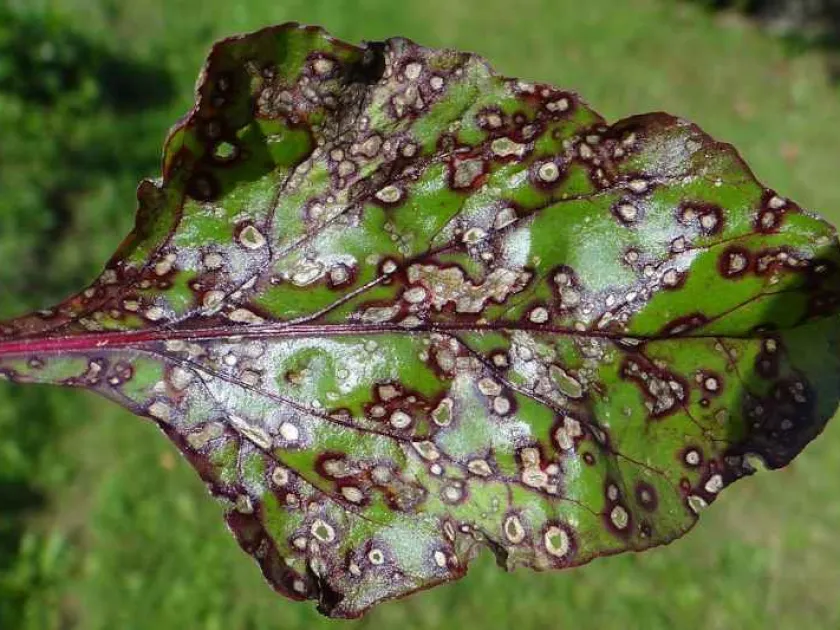
The diagnostic sign is the formation of small, circular lesions (2-4 mm in diameter) with distinct reddish-brown or purple margins on the leaf blade.
As the lesions mature, the centers become light gray or tan. Under high humidity, a velvety, gray-colored fungal growth (conidia) becomes visible in the center of the spots.
In advanced stages of infection, multiple spots coalesce, resulting in large, necrotic areas that cause the entire leaf to yellow and wither. The leaves then collapse and turn brown, often leaving the plant with only a small tuft of central leaves.
The petioles and stems can also be infected, showing elongated, dark-colored lesions. However, the most characteristic symptom remains the spotted, necrotic appearance of the mature leaves.
Differentiating this from other leaf diseases is crucial. Cercospora spots are smaller and more uniform in shape compared to Phoma leaf spot, and the distinct gray sporulation is a key identifying feature.
Control measures
The use of resistant or tolerant beet varieties is the cornerstone of an integrated pest management program. Selection of such hybrids significantly reduces the disease pressure in the field.
Crop rotation remains a fundamental practice to allow infected residues to decompose. A minimum break of three years between sugar beet crops is generally recommended for effective sanitation.
Fungicide application is necessary when symptoms reach the economic threshold. Growers often rotate classes of fungicides, such as triazoles and strobilurins, to manage the risk of pathogen resistance.
Sanitation practices, including deep plowing to bury debris and controlling weed hosts like wild beet or amaranth, help reduce the initial inoculum load in the field.
Monitoring fields regularly for the first signs of leaf spots is vital for timely intervention. Proper nitrogen management and preventing excessive canopy density can also minimize the humidity levels favorable for the fungus.
Causes diseases · 1
Discussion
No discussions yet — be the first.