
Cercosporella leaf spot
Cercosporella brassicae
Description
How to identify
Cercosporella brassicae is a pathogenic fungus that specifically targets plants in the Brassicaceae family. It is a filamentous pathogen that thrives under cool and humid environmental conditions.
The fungus overwinters primarily on infected crop debris left in the field, surviving as mycelium or conidia until the next growing season when environmental factors trigger sporulation.
Spore dissemination is facilitated by wind currents and water splashing during rainfall, which transfers the pathogen from the soil or lower leaves to the healthy foliage of the canopy.
Morphologically, the fungus is characterized by the production of conidia on white to gray stromatic tufts that appear on the undersides of necrotic spots on the leaves.
It is classified within the group of Ascomycota and represents a significant agricultural challenge due to its ability to rapidly proliferate in damp microclimates within dense crop stands.
What it damages
This pathogen affects a wide range of important agricultural crops, including various cabbage species, cauliflower, broccoli, rapeseed (canola), and mustard crops.
In seed production fields, the impact is particularly severe as the fungus colonizes stems, flower stalks, and siliques, causing significant reductions in seed yield and viability.
In leafy vegetables, the damage results in premature senescence of lower leaves, which limits the overall photosynthetic capacity of the plant and hinders head development.
Severe infestations reduce the market value of the produce, as infected plants are susceptible to rotting during storage and transportation processes.
Widespread infection can lead to substantial economic losses, especially in regions with frequent rain and high humidity during the critical stages of crop development.
Signs of infestation
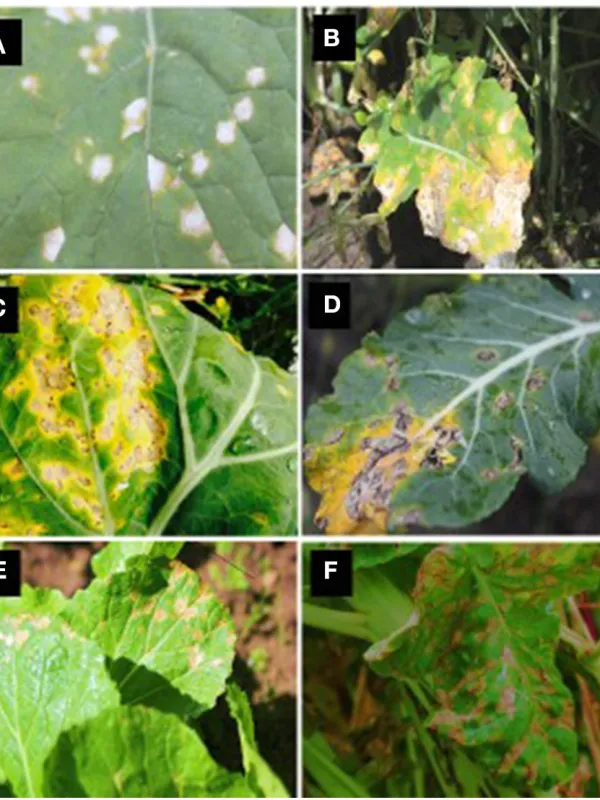
Early symptoms of the disease manifest as small, circular or irregular spots, typically white to light gray in color, surrounded by a distinct dark-colored margin.
As the infection progresses, these spots expand in size and often coalesce, resulting in large, necrotic areas that can cover the majority of the leaf surface.
A diagnostic feature is the appearance of a thin, whitish mold-like layer of fungal conidia on the underside of the leaves precisely where the necrotic spots are located.
Heavily infected leaves turn yellow, become brittle, and eventually drop off, leading to defoliation that weakens the plant's structural integrity.
Stems and leaf petioles may also display elongated lesions, which can lead to plant stunting and reduced vitality under high infection pressure.
Control measures
Implementing a strict crop rotation strategy is essential, ensuring that Brassicaceae crops are not planted in the same field for a minimum of three to four years.
Sanitation is a critical control measure, involving the thorough incorporation of crop residues into the soil through deep plowing to speed up decomposition and eliminate inoculum sources.
Integrated weed management must be prioritized, as wild cruciferous weeds act as secondary hosts for the fungus, perpetuating the disease cycle throughout the season.
The application of registered systemic fungicides is recommended when environmental conditions favor disease development or at the first sign of symptoms in the crop.
Proper field management, including optimized plant spacing to improve air circulation and controlled irrigation to reduce leaf wetness, helps to create an environment less conducive to fungal growth.
Causes diseases · 1
Discussion
No discussions yet — be the first.