
Cercosporidium henningsii
Cercosporidium henningsii
Description
How to identify
Cercosporidium henningsii is a fungal plant pathogen belonging to the class Deuteromycetes. It is widely recognized in mycology as the agent responsible for various leaf spot diseases.
Currently, scientific literature often reclassifies this fungus under the genus Passalora, known as Passalora henningsii, reflecting its complex taxonomic status.
The fungus is a specialized parasite that reproduces through conidia, which are structures designed for dispersal via wind, water splashes, and physical contact within a plantation.
It thrives in tropical environments, utilizing specialized microscopic structures to penetrate the host's leaf tissue and extract nutrients from the plant cells.
In laboratory analysis, the pathogen forms distinctive olive-brown colonies on standard media, providing a clear visual identification characteristic for diagnostic purposes.
What it damages
The primary host for Cercosporidium henningsii is cassava (Manihot esculenta), a staple food crop for millions of people in tropical and subtropical regions.
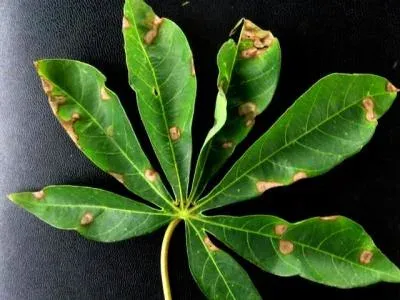
The fungus causes brown leaf spot disease, which can significantly reduce the photosynthetic capacity of the plant by causing widespread necrosis on the foliage.
Reduced photosynthetic efficiency directly impacts the yield of cassava tubers, leading to stunted growth and lower starch content in the roots at harvest.
In cases of severe infestation, the pathogen causes premature leaf senescence and abscission, leaving the plant vulnerable to secondary infections and environmental stress.
Beyond cassava, the disease can affect other members of the Euphorbiaceae family, meaning it can persist in diverse agricultural settings if left unchecked.
When it appears
Disease progression is highly dependent on climate conditions. It flourishes during high-humidity seasons, particularly during the rainy months in tropical climates.
The optimal temperature for conidia germination and colonization of leaf tissues typically ranges from 22°C to 28°C, which is common in many cassava-growing regions.
The disease cycle intensifies during periods of prolonged rainfall, as water droplets facilitate the movement of spores from the soil or lower leaves to healthy foliage.
Incidence usually peaks in the second half of the growing season as the crop canopy closes, creating a humid microclimate that favors fungal development.
Dry periods act as a limiting factor, though the fungus survives these unfavorable conditions in a dormant state within crop residues or infected soil particles.
Signs of infestation
Initial symptoms are characterized by small, brown, circular-to-angular spots appearing on the leaves. These spots are often surrounded by a chlorotic yellow halo.
As the infection progresses, the spots expand and may coalesce, forming large, irregular necrotic lesions that cover significant areas of the leaf surface.
On the underside of the leaves, the central part of the spots develops a velvety, olive-gray appearance, representing the sporulation layer of the fungus.
As the disease worsens, the leaves turn yellow, wilt, and eventually drop off. This "scorched" effect is a classic sign of advanced Cercosporidium infection.
- Brown spots with yellow halos
- Velvety olive-gray sporulation on the leaf underside
- Premature yellowing and leaf shedding
- Reduced plant vigor and stunted growth
- Irregular necrotic leaf lesions
Control measures
The most effective management strategy is the use of resistant or tolerant cassava cultivars, which significantly reduce the susceptibility of the crop to the pathogen.
Sanitation practices, such as the removal and destruction of crop debris after harvest, are essential to minimize the primary inoculum load in the soil.
Maintaining proper plant spacing improves air circulation within the field, which helps to lower humidity levels and suppresses the rapid spread of the fungus.
Fungicide applications, particularly those containing copper compounds or triazoles, can be used as a last resort in high-pressure commercial plantations.
Crop rotation with non-host species is highly recommended to break the life cycle of the pathogen and prevent its buildup in the soil over successive years.
Causes diseases · 1
Discussion
No discussions yet — be the first.