
Cauliflower fungus
Sparrasis crispa
Description
How to identify
The cauliflower fungus (lat. Sparassis crispa) is a member of the kingdom Fungi, phylum Basidiomycota, and class Agaricomycetes. In forest pathology, it is recognized as a serious pathogen affecting the root systems of living conifers.
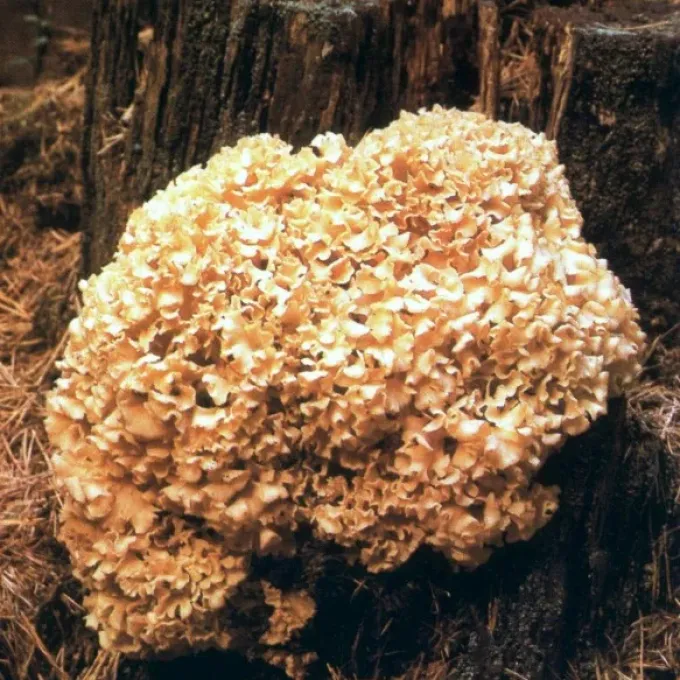
The fruiting body is highly distinct, characterized by a complex structure of ruffled, leaf-like branches that resemble a cauliflower head. It typically ranges from white to yellowish or tan in color.
As a parasite, it attacks trees by invading the roots through bark injuries or root grafts. It secretes enzymes that efficiently break down cellulose and lignin, the primary components of wood.
The fungus is a member of the Sparassidaceae family. Unlike many other fungi that only act as decomposers on dead wood, Sparassis crispa is capable of actively infecting healthy trees, significantly impacting forest productivity.
It remains persistent in the forest environment for many years, surviving on dead wood, old stumps, and within the root systems of trees it has already infected, making it difficult to eradicate.
What it damages
The primary hosts of this fungus are pine trees (Pinus species), although it is also known to infect spruce, larch, and fir. It is a major agent of brown root and butt rot.
The disease process involves the decay of the inner wood of the roots and the base of the trunk. This degradation drastically reduces the tree's structural integrity, leading to significant timber losses.
Infected stands often experience high rates of windthrow. Because the roots are compromised, the trees become unstable and are easily blown over during moderate wind events, causing gaps in the canopy.
The pathogen spreads through the soil via root-to-root contact. This transmission method creates expanding "disease centers" where older trees die and younger replacements become infected shortly after planting.
Economically, the presence of this pathogen in a forest reduces the volume of harvestable timber, lowers the wood quality, and necessitates costly salvage logging operations to control the spread of the disease.
When it appears
Fruiting bodies of the cauliflower fungus typically appear in late summer and autumn, particularly during August and September, following periods of increased rainfall.
The mycelium within the roots and stumps remains active throughout the year, provided temperatures are sufficient to support metabolic activity within the wood tissue.
Spore dispersal is facilitated by wind currents. These spores settle on damaged surfaces or cracks in the bark of healthy trees, initiating new infections during favorable moist conditions.
During the winter months, the fungus enters a dormant state within the infected root tissues. It survives the cold season by remaining sheltered inside the host's woody structure, ready to resume growth in spring.
Field foresters recommend conducting surveys for fruiting bodies at the base of trees in the late summer, as this is the most reliable time to confirm the presence of the fungus in a forest stand.
Signs of infestation
The presence of cauliflower-shaped fruiting bodies at the base of the tree is the most certain diagnostic sign. These clusters are quite unique and easy to spot when they emerge.
Symptoms in the tree crown include reduced foliage density, yellowing needles, and stunted growth. These signs indicate that the root system is failing to provide adequate water and nutrients to the canopy.
The wood at the base of an infected tree often shows signs of advanced decay. If the bark is removed, you may see white, thick mycelial mats covering the root collars.
Windthrow is a classic late-stage sign. If trees fall over with roots that show evidence of brown, brittle, cube-like decay, it is highly likely that this fungus is the cause.
- Presence of characteristic cauliflower-like fruiting bodies.
- Premature needle drop and crown thinning.
- Structural instability and fallen trees.
- Brown, crumbly rot discovered in roots or stumps.
Control measures
Effective control relies heavily on sanitary harvesting. Infected trees must be removed, including their stumps, to prevent the pathogen from surviving in the soil or moving to adjacent healthy trees.
Forest management practices should emphasize the protection of root systems. Machinery used in forestry must avoid bruising or cutting roots, as these wounds provide easy entry points for spores.
Biological control methods are being explored, particularly the use of antagonistic fungi like Trichoderma, which can compete with the pathogen and inhibit its growth in the soil.
When reforesting affected areas, it is advisable to choose resistant species or implement mixed-species planting. This strategy breaks the continuity of susceptible root networks in the soil.
Consistent monitoring and early detection are key. By identifying infected clusters early, foresters can perform focused removals, preventing the loss of wider areas of timber and maintaining stand health.
Causes diseases · 1
Discussion
No discussions yet — be the first.