
Botryosphaeria dothidea
Botryosphaeria dothidea
Botryosphaeria dothidea is an ascomycete fungus that acts as a serious plant pathogen. It belongs to the family Botryosphaeriaceae and the order Botryosphaeriales, causing diverse diseases across a wide range of woody hosts.
What the section contains
Botryosphaeria dothidea
The fungus exists primarily as a latent endophyte, meaning it can colonize healthy plant tissue without causing immediate symptoms. Once the host plant is stressed or weakened, it transitions into a necrotrophic pathogen.
It reproduces via both sexual (ascospores) and asexual (conidia) stages. These spores are produced in fruiting bodies called pycnidia, which serve as the primary source of infection in orchards and nurseries.
Distributed globally, this pathogen is especially prevalent in temperate and subtropical climates. Its ability to remain dormant within host tissue makes it particularly difficult to manage in commercial fruit production.
Microscopic identification is necessary for definitive diagnosis. Researchers typically look for specific conidial morphology within the pycnidia found on the outer bark of infected branches or trunks.
##damage##The pathogen is known to infect a variety of important crops, including apple, pear, peach, grapevine, and various ornamental trees. It causes significant losses by killing productive wood.
The disease primarily manifests as bark cankers, dieback of branches, and fruit rot. Cankers are localized areas of dead bark that can girdle a branch, cutting off nutrient transport and causing wilting.
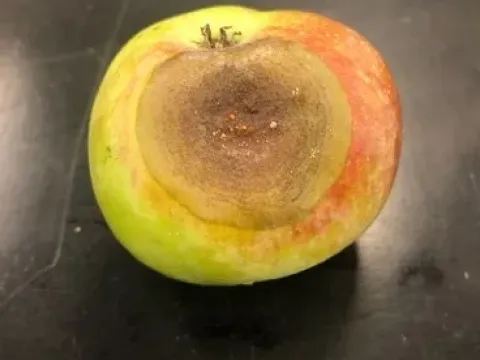
In fruits, the fungus causes dark, sunken lesions that rapidly spread throughout the flesh. This turns the fruit into a soft, rotten mass, rendering it completely unsalable and unsuitable for processing.
In nurseries, Botryosphaeria dothidea can lead to the death of young saplings, causing substantial economic setbacks. The presence of the pathogen in young tissue often limits future productivity.
Infection often exploits wounds caused by pruning, insects, or environmental stress such as drought or cold injury. These wounds serve as entry points where the fungal spores germinate and colonize.
The peak activity of the fungus occurs during the warmer months. Spore production and dispersal are highly dependent on moisture; rainfall triggers the release of conidia from the pycnidia.
Spring and summer are considered high-risk periods. Frequent heavy rain followed by humidity provides the ideal environmental conditions for the infection to spread across the orchard canopy.
During the dormant winter season, the fungus survives as mycelium within the infected tissues of the branches or trunk. It stays protected beneath the bark, waiting for the return of favorable conditions.
Continuous spore production can occur throughout the growing season. Management strategies must therefore be proactive, focusing on preventing infections before the rainy periods begin.
Monitoring for signs of the disease is most critical following periods of extreme weather, which may stress the trees and make them more susceptible to colonization by the pathogen.
Early symptoms include the appearance of small, reddish or brown spots on the bark. As the disease progresses, these areas dry out and form sunken cankers, often resulting in bark cracking.
The characteristic sign of the infection is the presence of small, black, pin-head-sized pycnidia erupting through the bark surface. These are easily visible during wet weather or upon close inspection.
Infected branches may show premature yellowing of leaves and gradual wilting. If the canker girdles the entire branch, the foliage will turn brown and wither completely, while the wood itself dies.
Fruit rot appears as circular, dark, or firm spots that expand rapidly. In advanced stages, the internal tissue becomes mushy and discolored, often accompanied by secondary infections.
A cross-section of an infected branch often reveals deep brown discoloration of the xylem. This internal necrosis confirms the presence of the pathogen deeper within the vascular system.
The cornerstone of management is rigorous sanitation. All infected branches must be pruned away, and the removed wood should be destroyed or burned to prevent further spore spread.
Always disinfect pruning tools between trees to prevent mechanical transmission of the fungal spores. Properly sealing large pruning wounds with specialized wound dressings can provide additional protection.
Chemical control involves the use of copper-based fungicides for prevention or triazoles for systemic protection. Applications are most effective when timed before expected rain events during the growing season.
Maintaining tree vigor is essential for natural defense. Provide balanced fertilization and irrigation to ensure the tree is not stressed, as healthy trees are better equipped to wall off localized infections.
- Remove all deadwood from the orchard annually.
- Avoid wounding tree trunks during cultivation.
- Ensure adequate canopy ventilation through proper pruning.
- Use certified disease-free nursery stock.