
Phragmidium violaceum
Phragmidium violaceum
Description
How to identify
Phragmidium violaceum is a pathogenic fungus belonging to the order Pucciniales. It is a highly specialized parasite responsible for the disease known as blackberry rust, affecting plants within the Rubus genus.
This organism follows a complex lifecycle consisting of several spore stages. As an autoecious rust, it completes its entire developmental cycle on a single host plant, which facilitates its rapid propagation in favourable environments.
The fungus typically overwinters as teliospores embedded in fallen leaves or on the woody stems of infected blackberry canes. When spring temperatures rise, these spores germinate, producing basidiospores that initiate new infections.
Within the host tissue, the mycelium grows intercellularly, absorbing nutrients and eventually breaking through the epidermis to form fruiting structures (pustules). This invasive growth directly compromises the plant's health.
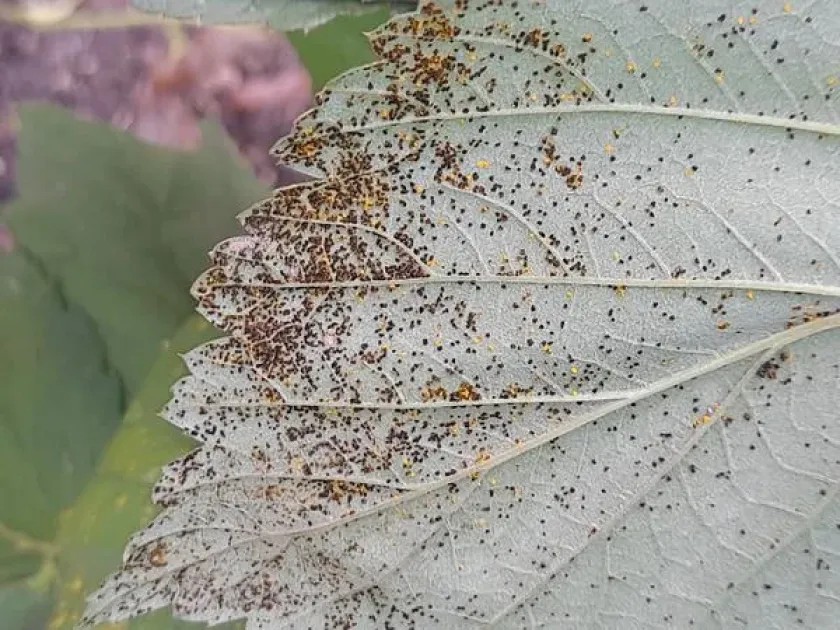
Identification is aided by the presence of distinct pustules that vary in colour from bright orange (during the active growth phase) to dark brown or black (during the overwintering stage).
What it damages
The primary hosts of this pathogen are various species of blackberry (Rubus fruticosus agg.). It poses a significant threat to both commercial orchards and home garden berry patches.
The damage caused is primarily physiological; the fungus disrupts the photosynthetic process, leading to the yellowing and necrosis of foliage. This loss of leaves severely reduces the plant's carbohydrate reserves.
Stem infection is particularly destructive. Pustules forming on the canes create deep lesions that hinder the transportation of water and nutrients, often resulting in cane dieback and stunted development.
Fruit quality is also heavily impacted. Infected plants often produce smaller, deformed, and unmarketable berries, causing substantial economic losses for growers who rely on berry production.
Long-term infestation weakens the overall vigour of the plant, making it significantly more susceptible to environmental stress, frost damage, and secondary infections from other pathogens.
When it appears
Blackberry rust typically appears during the late spring or early summer, following periods of mild, wet weather. Optimal development occurs between 15°C and 22°C with high humidity levels.
Mid-summer represents the peak of infection, as urediniospores are produced in large numbers. During this time, spores are easily dispersed by wind and splashing rain, allowing the disease to spread rapidly.
As autumn approaches, the fungus shifts towards the production of teliospores. These darker structures indicate that the pathogen is transitioning into a dormant state, preparing for the winter period.
In regions with mild winters, the fungus may remain active on evergreen leaves, continuing to produce spores throughout the year and ensuring a constant presence in the local environment.
Managing the disease requires vigilance throughout the growing season, particularly during humid spells when the infection rate is at its highest.
Signs of infestation
The initial signs of infection are small, bright yellow to orange spots appearing on the upper surface of the leaves, corresponding to the internal growth of the fungus.
As the disease progresses, corresponding pustules (aecia) appear on the underside of the leaves. These pustules often exhibit a characteristic purple or violet halo, which serves as a diagnostic feature.
Stems may develop swollen, blister-like areas that eventually rupture, revealing masses of dark spores. These lesions can cause the canes to crack or bend, indicating severe systemic infection.
Defoliation is a common symptom in later stages. The plant sheds infected leaves prematurely, leaving the canes bare and exposed, which significantly reduces the plant's ability to survive winter conditions.
- Bright yellow or orange spots on leaf blades.
- Distinct violet-coloured halos around infection sites.
- Ruptured pustules on stems and canes.
- Premature leaf drop and cane dieback.
- Distorted and shrivelled fruit production.
Control measures
Sanitation is the most effective cultural control method. Gardeners should prune and destroy all infected canes and rake up fallen leaves to remove the primary source of overwintering inoculum.
Improving air circulation is essential. Proper spacing of plants and regular thinning of excessive cane growth reduce the humidity around the leaves, making the environment less hospitable to fungal spores.
Copper-based fungicides can be applied as a preventive measure in the early spring. These treatments help protect the emerging foliage from initial infections during the critical spring period.
In cases of severe outbreaks, systemic fungicides may be necessary. It is crucial to follow local guidelines regarding application frequency and the required pre-harvest interval to ensure safety.
Selecting resistant cultivars remains the best long-term strategy for managing Phragmidium violaceum, reducing the reliance on chemical interventions while maintaining healthy yields.
Causes diseases · 1
Discussion
No discussions yet — be the first.