
Phoradendron tomentosum
Phoradendron tomentosum
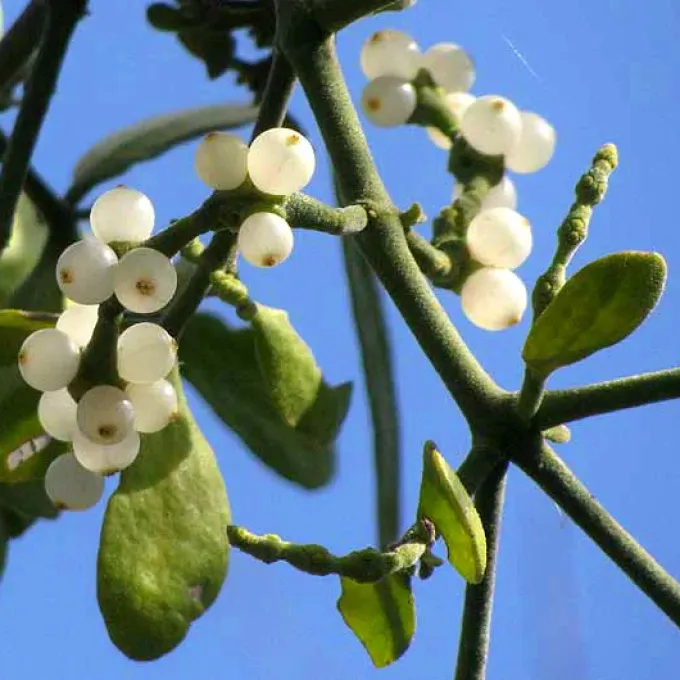
Description
How to identify
Phoradendron tomentosum is an obligate hemiparasitic plant species belonging to the Santalaceae family. It is a perennial shrub that survives by anchoring itself to the branches of host trees using specialized root-like structures called haustoria.
The name reflects the dense, hair-like covering (tomentose) on its young stems and leaves, giving the plant a gray, velvety appearance. Despite being photosynthetic, it relies heavily on the host tree for water and minerals.
Taxonomically, it is classified within the order Santalales. The species is widespread, particularly in warmer climates, where it thrives on various woody hosts in both natural and urban environments.
Its life cycle is closely linked to bird populations. Birds ingest the sticky berries and distribute the seeds onto tree branches, where the viscin substance helps the seed adhere to the bark until germination occurs.
Unlike holoparasites, it possesses green chlorophyll-containing tissue, yet its dependency on the host's xylem classifies it as a significant threat to the physiological integrity of affected trees.
What it damages
This parasite typically colonizes a wide range of broad-leaved hosts, including oak, walnut, poplar, willow, and various ornamental or fruit-bearing trees. Urban landscapes, such as parks and boulevards, are frequently affected.
The damage is primarily caused by the sustained extraction of water and vital nutrients. This persistent drain often leads to a gradual decline in the host's overall health and vigor.
Heavily infested trees show reduced growth rates, premature leaf senescence, and increased vulnerability to environmental stresses like drought or heatwaves. Over time, large branches may suffer from dieback.
The entry points of the haustoria create structural weaknesses in the branches. These wounds serve as open gates for secondary pathogens, including wood-decaying fungi and various opportunistic bark beetles.
In extreme cases, if the infestation covers a significant portion of the tree's canopy, it can lead to the death of the entire tree due to physiological stress and resource depletion.
Signs of infestation
The most prominent sign is the presence of bushy, evergreen clumps within the canopy that remain visible even after the host tree sheds its leaves during the dormant season.
On the affected branches, one may observe noticeable swelling, galls, or localized deformations where the parasite has penetrated the bark. These are signs of the host's defensive growth response.
The berries of Phoradendron tomentosum are another diagnostic feature. They are often translucent and white or pinkish, clustering along the stems and standing out against the background of the tree.
Affected branches often exhibit stunted development of leaves and twigs distal to the site of infestation, indicating a disrupted supply of water and essential nutrients reaching the outer canopy.
Growth abnormalities, such as dense clusters of leaves known as "witches' brooms," may also appear on the host tree, caused by the physiological disruption induced by the parasite.
Control measures
The primary control method is physical removal via pruning. Branches must be cut back at least 30 to 50 centimeters below the point of infection to ensure the complete removal of the internal haustorial system.
Maintaining tree health through proper irrigation and fertilization is crucial, as vigorous trees are more resilient against colonization by parasitic plants.
Regular canopy inspections during the dormant season are recommended to identify and remove small clusters before they mature and produce seeds, preventing the spread of the pathogen.
In specialized cases involving high-value trees, systemic chemical treatments or tree injections may be considered, provided they are managed by professional arborists to ensure host safety.
- Systematic pruning of infested branches
- Proper hydration and soil nutrient management
- Dormant season visual monitoring
- Minimizing bark injuries to reduce colonization sites
Causes diseases · 1
Discussion
No discussions yet — be the first.