
Phoradendron flavescens
Phoradendron flavescens
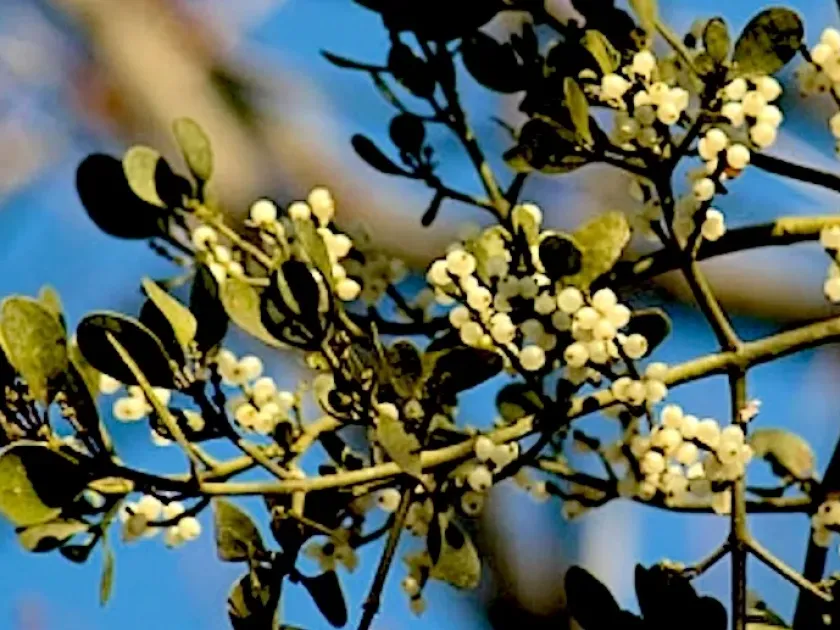
Description
How to identify
Phoradendron flavescens, commonly known as American mistletoe, is a perennial evergreen shrub belonging to the Santalaceae family. It is an obligate hemiparasite that attaches itself to the branches of host trees to extract essential water and nutrients.
The plant features leathery, opposite leaves that are yellowish-green in color. Its structure is highly specialized; instead of traditional roots, it develops haustoria—root-like structures that penetrate the bark and xylem of the host to create a permanent vascular connection.
Flowering occurs in small, inconspicuous spikes, leading to the production of white, semi-translucent berries. These berries contain a sticky substance that allows seeds to attach to the feet or beaks of birds, facilitating long-distance dispersal.
Although the plant performs photosynthesis, it relies heavily on its host. It is structurally adapted to live high in the canopy, making it a distinctive component of many forest and urban ecosystems across North America.
This species is well-studied in plant pathology as a major hemiparasitic pathogen that can persist on a single host for many years, gradually expanding its biomass.
What it damages
Phoradendron flavescens targets a wide variety of deciduous tree species, including oak, maple, hickory, and fruit trees such as apple. By tapping into the xylem, the parasite deprives the host of vital fluids.
This resource theft leads to significant physiological stress for the host. The branch beyond the point of attachment often exhibits stunted growth, reduced leaf size, and lower overall vigor.
The physical penetration of the haustoria causes localized swelling and wood deformation. In some cases, this leads to the formation of "witches' brooms" or galls, which weaken the structural integrity of the host's limbs.
Prolonged infestation can lead to the dieback of major branches. In cases of extreme colonization, an entire tree may become so weakened that it becomes susceptible to secondary pests, wood-boring insects, and fungal decay.
Economic damage is most felt in orchards and urban forestry, where the presence of mistletoe reduces the lifespan of trees, ruins the tree's ornamental value, and necessitates expensive maintenance operations.
Signs of infestation
The most prominent sign of infestation is the appearance of dense, green clumps in the canopy. These are especially visible during the winter months when host trees have dropped their foliage.
Upon closer inspection, the point of attachment is marked by distinct bark swelling or tumor-like growths. The bark in these areas may be rough, cracked, or show signs of abnormal wood growth.
The affected branches often display chlorotic or wilted leaves during the growing season. A gradual die-off of the distal portion of the branch is a reliable indicator that the parasite is successfully intercepting the water supply.
- Evergreen leafy clumps visible in dormant deciduous trees.
- Swollen, gnarled bark at the site of attachment.
- Clusters of white, sticky berries present in the fall and winter.
- Reduced vitality and annual growth of the host branch.
The distinct contrast between the green mistletoe and the bare branches of a dormant host is the primary diagnostic feature used by foresters and homeowners for identification.
Control measures
Mechanical removal is the most effective way to manage the parasite. Pruning the infested branch at least 15–20 centimeters below the point of attachment is necessary to remove the hidden haustorial roots that extend into the host's wood.
Sanitation is crucial; all pruning tools should be disinfected with a bleach or alcohol solution between cuts to prevent the potential spread of pathogens or plant tissue fragments to other healthy branches.
Chemical control options are limited. While some systemic herbicides exist, they are difficult to apply effectively without damaging the host tree itself, making manual removal the preferred practice in most landscapes.
Maintaining tree health is a vital preventive measure. Well-watered and properly fertilized trees exhibit stronger defensive responses and can better tolerate light infestations compared to stressed or neglected specimens.
Regular monitoring during the dormant season allows for early detection. Removing the parasite when it is still small significantly reduces the effort required and prevents the colonization of larger, more valuable structural branches.
Causes diseases · 1
Discussion
No discussions yet — be the first.