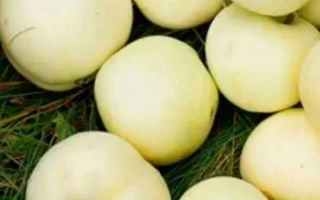
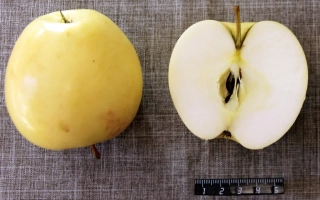
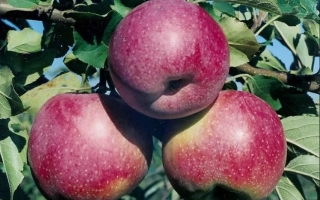
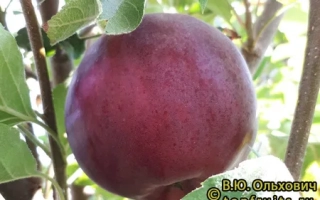
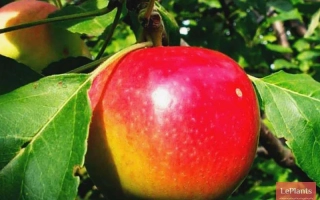
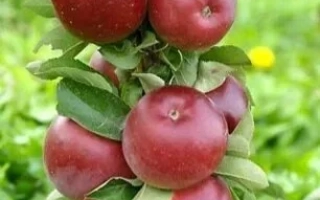
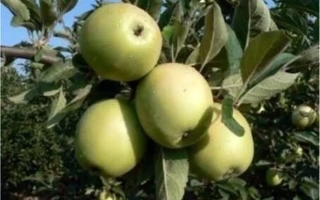
The winter apple variety Charovnitisa is a medium-sized tree with a round, compact crown and shoots directed strictly upwards towards the sunlight. This variety was created at the Fruit Growing Institute of the National Academy of Sciences of Belarus in 1963 by crossing the Belarusian Sinap and Renet Cox varieties. Charovnitisa bears mixed fruit, starting as early as the second year after planting on the 62-396 rootstock, and the fifth year when using seedling rootstock. When planted at a spacing of 5 by 3 meters, the yield reaches approximately 20 tons per hectare, and fruiting is usually systematic. The fruits of the Charovnitisa variety have a flat-round shape and an average weight of 100 to 120 grams. The skin is light yellow with a brownish-red blush and an oily texture; the subcutaneous dots are barely visible. The flesh of the apples is yellowish, finely grained, very juicy, and has a rich aroma. The taste of the fruits is pleasant and juicy, as confirmed by high tasting scores. Harvest occurs in early October, and the fruits store well in cool conditions, sometimes until the end of spring, allowing them to be used for a long time after harvesting. The Charovnitisa variety is characterized by high yield and good immunity to scab, but has a drawback in the form of low winter hardiness. In addition, apple trees are susceptible to diseases such as rust, gray mold, and powdery mildew, as well as pests, including spider mites, flower weevils, long-horned beetles, apple leafhoppers, and codling moths. For planting, saplings are supplied with an artificial earthen ball, which ensures the preservation of the root system and promotes successful establishment.