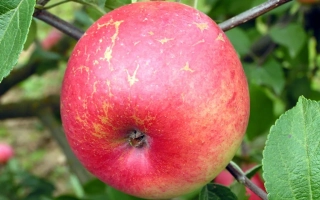
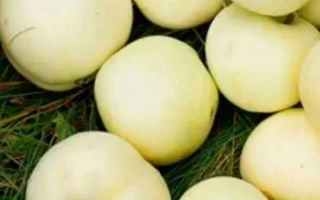
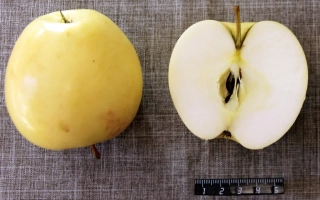
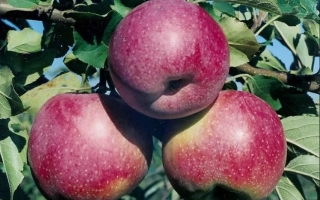
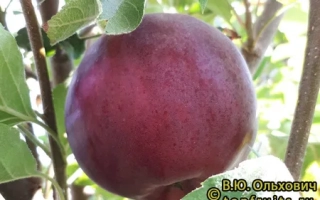
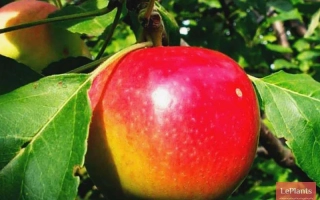
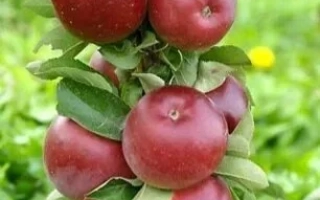
The Jonagold apple is a winter variety of American selection, bred in 1943 by crossing the Jonathan and Golden Delicious varieties. This variety is characterized by vigorous trees with a wide-oval crown in youth, which over time becomes bucket-shaped and of medium density. Skeletal branches depart from the trunk at a wide angle. Flowering occurs in medium terms, and the onset of fruiting occurs as early as the 2-3rd year after planting. The apple tree is triploid, and for better pollination, it is recommended to use the Idared, Gloster, Jonathan, Elstar, Cox Orange Pippin, and Champion varieties. The fruits of the Jonagold variety are large, weighing 160-170 grams, round-oval in shape, and uniform. Their skin is of medium thickness, dense, elastic, smooth, and shiny, with a yellowish-green color and a bright orange-red blurred-striped blush covering about two-thirds of the surface. The flesh is yellow, dense, and juicy, with a very harmonious sweet-and-sour taste, which received a high tasting score of 4.6 out of 5 points. The fruits ripen at the end of September to the beginning of October and can be stored under ordinary conditions until January-February, and in the refrigerator until April. The variety is characterized by high yield and good transportability, which makes it attractive for commercial cultivation. Under Ukrainian conditions, the yield of 5-7-year-old trees is from 10 to 15 kg, and 10-year-old trees yield 40-55 kg per tree. Despite medium resistance to scab and low resistance to powdery mildew, Jonagold is popular due to the excellent commercial appearance of the fruits and their taste qualities. The trees have medium winter hardiness and are characterized by medium shoot power with a lack of pubescence.