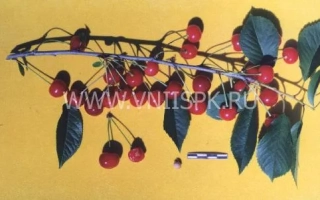
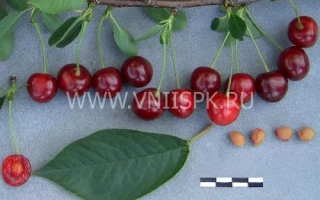
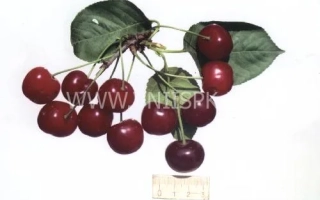
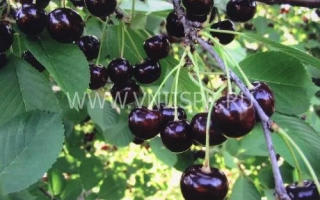
Introduced at the Rossoshanskaya Zonal Experimental Station for Horticulture by A.Y. Voronchikhina through sowing seeds of a local variety called 'Gin' Red from open pollination. The paternal variety is likely 'Denissen Yellow', as trees of this variety grew near 'Gin' Red trees and Julia resembles them in crown shape and several other pomological traits. Since 1992, the variety has been officially approved for the Central Chernozem region. It has gained significant popularity in southern Voronezh and Belgorod regions, where it is highly favored by amateur gardeners.
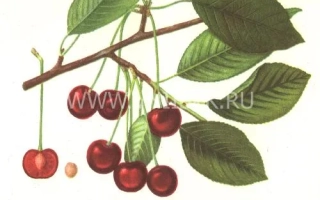
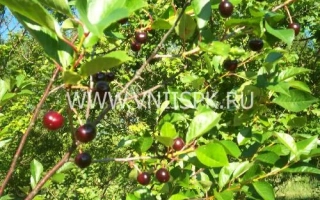
The tree is fast-growing, vigorous, and very vigorous, reaching 7-8 meters or more in maturity. The crown is oval with drooping lower branches, dense, and well-leafed. The bark on the trunk is gray with a cherry-like sheen, smooth or slightly rough, slightly flaking, with weak longitudinal cracking and weak or absent spiral cracking. Buds are convex, ranging from short to very long, fairly wide, densely arranged. Shoots are straight or slightly curved, relatively thin, with long and very long internodes, initially yellow-green, then acquiring a silvery-gray hue on the sunlit side, but remaining greenish in shade. Buds are very small, whitish, oval to elongated-oval, longitudinally cracked, densely arranged. Vegetative buds are very large, 6-7 mm long, conical with a pointed apex, separated, rarely protruding. Flowering buds are also large, 5-6 mm long, rarely 4 mm, egg-shaped with a short-pointed apex, separated or protruding. Leaf blade is elongated-oval or elongated-egg-shaped with a gradually tapered apex (rarely sharply tapered) and rounded or arcuate base, 13-15 cm long, 5-7 cm wide on one-year shoots; dark green above, slightly wrinkled along veins, slightly concave along central vein, slightly glossy; pale green below with distinct vein mosaic, sparse pubescence: leaf margin is coarse, doubly-toothed, blade elastic. Petiole is very long, 30-40 mm long, relatively thin with sparse pubescence, especially above; anthocyanin coloration weak, dirty-red. Stipules absent. Inflorescence has 2-3 flowers, 30-35 mm in diameter, ranging from cup-shaped to flat, occasionally petals slightly curled backward; petals white, not closed, inversely egg-shaped or rounded-oval; stigma level with stamens, stamen length 6-12 mm, stigma with ovary about 15 mm. Calyx is bell-shaped or cup-shaped, slightly swollen at the base, calyx lobes elongated-lanceolate, curled backward and pressed against the calyx tube, equal or exceeding tube length, margins entire, tube length 5-6 mm, calyx lobes 6-7 mm; pedicel, tube, and calyx lobes uncolored, but calyx lobe reflexion is whitish. Flowering occurs in early-mid season, the variety is self-sterile.
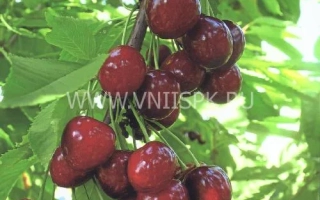
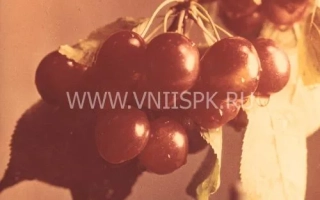
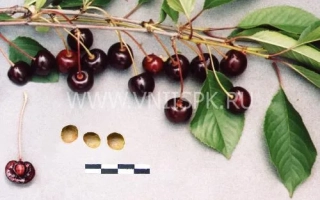
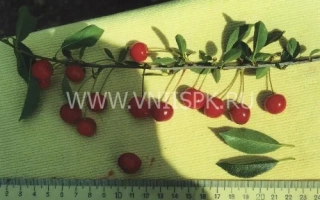
Fruits average 5.6 g, up to 7-8 g on young trees, fruit height 22 mm, width 22 mm, thickness 19 mm; fruit shape round or heart-shaped, moderately flattened laterally, wide shallow depression, rounded apex, stigma remnant as a point. Fruit color is creamy-yellow, with a bright pink-red blush covering the entire surface, especially on well-lit fruits which have a very attractive appearance; in shaded fruits, the blush is weaker. Flesh is creamy, dense (bigarre), moderately juicy, juice colorless. Flavor is sweet with a slight pleasant acidity, simple, tasting score 4.4 points. Fruits contain 18.9% (18.44-19.34%) soluble solids, 14.0% (13.53-14.52%) sugars, 0.59% (0.67-0.50%) titratable acids. Pedicel 42-47 mm long, 1 mm thick, easy to detach dry at full maturity. Pit average 0.47 g, making up 8.4% of fruit mass, rounded to rounded-oval shape, apex rounded, base rounded, fresh pit color brownish-yellow, easily separates from flesh. Fruits ripen in mid-late season, in southern Central Chernozem zone by late June to early July.
Trees grafted onto Antipka enter fruiting 4-5 years after planting in the garden, with low early fruiting potential and slow increase in yield. However, in mature age, yield is high. Average yield over ten years of fruiting was 28.4 kg/tree, reaching up to 54.1 kg/tree in the most productive years. In 2004, individual 15-year-old trees yielded up to 110 kg/tree.
One of the most winter-hardy cherry varieties. Overall degree of freezing damage to trees after harsh winters over the last 50 years did not exceed 2.0 points, and survival rate of trees 16 years after planting was 100%. Winter hardiness of flower buds is also high. After a frost of -34.0°C on December 17, 1997, only 38.8% of flower buds died. In the unfavorable winter of 1993-1994, when temperatures dropped to 32.5°C in early February after a strong and prolonged thaw in December-January, flower bud mortality was 70.2%.
Resistance to coccomyces is high, no moniliosis infections were recorded over all study years.
Advantages of the variety: high winter hardiness of trees and flower buds, dense, transportable fruits with good flavor.
Disadvantages of the variety: overly large tree, low early fruiting potential.