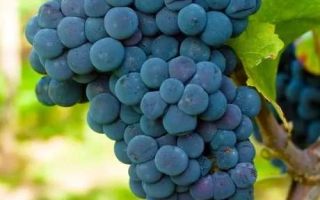
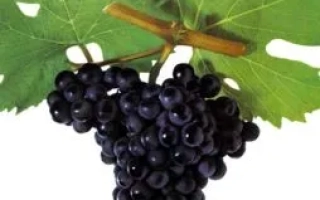
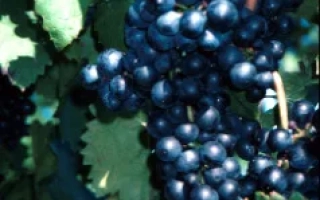
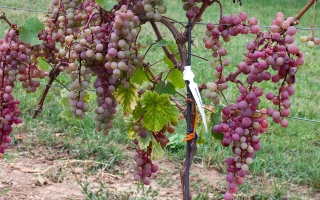
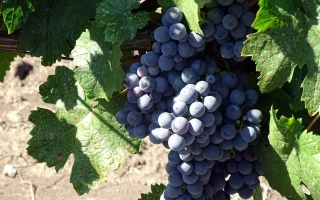
Cobert 5BB is an old and widely used grapevine rootstock, resulting from a cross between wild American varieties, developed by the French agronomist Évrard Ressegue in 1886. The seeds were passed on to the Hungarian viticulturist Teleki, who planted 40,000 seedlings, and selected specimens were sent in 1904 to the Austrian viticulture inspector Cobert, who systematized and named the rootstocks. Cobert 5BB is characterized by vigorous bushes with upright and long spreading canes, dense green-bronze crowns, large, round, dark green, leathery leaves with a petiole sinus shaped like the letter V. Bunches are small, loose, cylindrical-conical, berries are small, round, black with a bluish tint, seeds are small, 3-4 per berry. The flower is functionally female.
The agrobiological characteristics of this rootstock include a period from bud break to leaf fall of about 180 days at a sum of active temperatures of 3250 °C. Bushes are vigorous, cane length reaches 4-5 meters, the vine matures to 80%. The root system is strong, deeply penetrating into the soil to 7 meters and well-branched. The rootstock is resistant to phylloxera root form (4 out of 5 points), slightly affected by leaf form, has high bud winter hardiness and root frost resistance, which is especially important for southern Ukraine conditions. Additionally, the variety exhibits high drought tolerance and is not picky about soils, growing well on poor gravelly soils and slopes, tolerating high levels of soluble forms of lime up to 20%.
The grapevine rootstock Cobert 5BB enhances cane growth of the grafted variety and positively affects increasing average bunch and berry mass, contributing to increased yield. However, it may reduce berry quality and slightly delay ripening. The rootstock is suitable for light, permeable soils, but on very fertile soils it may transmit excessive growth vigor to the grafted variety, which worsens berry coloring and cane maturation. It is not recommended for varieties prone to flower drop during flowering. For agronomy, planting density is about 2000 vines per hectare with short-cane training and vertical trellising, with 16-18 green canes per bush, as well as mandatory pinching and suckering to improve cane maturation.