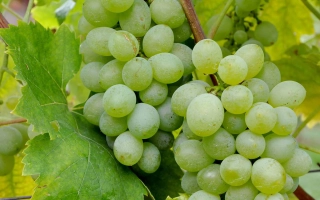
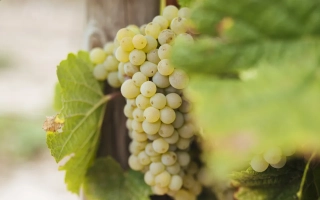
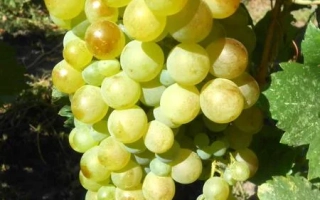
Aligoté is a white grape variety of French folk selection, belonging to the West European eco-geographic group. The leaves of this variety are entire, glossy, dark green in color with edges turned downwards, while the petioles and shoots are stained with a dark wine-red shade. The clusters are dense, cylindrical or cylindro-conical in shape, with small yellowish-green berries that have a round shape and a size of about 12-15 mm. The taste of the berries is pleasant, the pulp is juicy and tender, and the tasting score reaches 8.2 points. Aligoté is characterized by medium winter hardiness and good resistance to mildew, making it suitable for cultivation in various climatic conditions. Aligoté is widely used for the production of high-quality varietal juices, table wines, sparkling and blended wine materials. White wines from this variety are characterized by apple and citrus aromas and a delicate, light taste. Despite the fact that pure Aligoté wines do not always impress with their complexity, they are valued for their freshness and harmony, and often serve as a basis for creating other wine compositions. The variety prefers less fertile soils, on which other grape varieties grow worse, which allows for the effective use of diverse vineyards. Aligoté belongs to mid-late varieties with a ripening period of about 145 days. Clusters usually have a mass from 90 to 140 grams and may have a "wing." The sugar content in the juice varies from 17 to 22%, and acidity from 5.6 to 10%. For vine care, pruning to 3-5 buds is recommended. Grapes are well transported, which facilitates their use in the winemaking industry. In Burgundy, Aligoté holds the second place in prestige among white varieties after Chardonnay and is most often grown on hilltops or plains, where it shows the best results.