
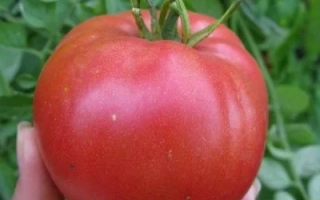

SKU #52194
·
55 views
PEPPER-SHAPED
Tomato
НПК «НК ЛТД»User rating
0 votes0% positive reviews
No ratings yet — be the first.
Product Type
Seeds; Seed material
Plant Type
Indeterminate
Maturation Period
120-130 days
Fruit Weight
100-150 grams, More than 200 grams
Prices in stores
from4.25 €per 1000 seeds
pack from 0.07 € per 0.1 g
23 offers from 15 stores
Store offers · 23 from 15 stores
Prices are updated on loadLoading offers…
Available at: Agroretail · Centre Liliya · Цибулинка · Dar Sad · Eco-Sadyba · Еліт насіння · Флора Сад · Garbuzyatko · Klop-Control · Online-Store · Povna Lavka · Rubus Plant · Дарвін · Веснодар · Все Росте · White Duck
Aggregator catalog: prices are collected automatically from store websites, normalized by AI and converted at the current exchange rate. Before ordering, confirm the price and availability on the store's website. This block is not indexed by search engines — the data is loaded after the page opens.
About product

Pepper-shaped tomato — a medium-early, medium-late indeterminate variety, characterized by high yield and unusual pepper-shaped fruits. Plants reach heights of 1.5 to 2 meters and form 4-5 branches, each bearing 4-9 fruits. Fruits weigh 100–200 grams, are up to 15 cm long, have juicy flesh, and excellent taste. They are dense, contain more sugar than regular tomatoes, making them ideal for fresh c…
Product Type
Seeds; Seed material
Plant Type
Indeterminate
Maturation Period
120-130 days
Fruit Weight
100-150 grams, More than 200 grams
Description
Pepper-shaped tomato — a medium-early, medium-late indeterminate variety, characterized by high yield and unusual pepper-shaped fruits. Plants reach heights of 1.5 to 2 meters and form 4-5 branches, each bearing 4-9 fruits. Fruits weigh 100–200 grams, are up to 15 cm long, have juicy flesh, and excellent taste. They are dense, contain more sugar than regular tomatoes, making them ideal for fresh consumption, canning, pickling, as well as for preparing baby food, tomato juice, and purée. Due to their density and firmness, fruits withstand transportation well and retain flavor during freezing and canning. The variety is resistant to many fungal and infectious diseases, simplifying care and increasing yield reliability. The plant is recommended for cultivation both in open ground and in greenhouses. Choose sunny locations with loamy, nutrient-rich soils protected from cold winds. Sow seedlings in March in large pots, transplanting them to their permanent location in May after frost threat, following a 70x70 cm spacing. Plants form one or two stems; for early and high yields, young tomatoes can be temporarily covered with plastic film or agrofiber. Care includes standard agronomic practices: regular watering, soil loosening, plant shaping, staking, fertilization, and pest control. It is recommended to plant tomatoes after legumes, cucurbits, and root vegetables, avoiding planting after potatoes, peppers, eggplants, and Physalis. Yield reaches up to 9 kg per square meter, making it attractive for gardeners who value the combination of taste, decorative appeal, and productivity.
Video · 6 videos
Suggest a video →Crop & resistance
Crop
Specifications hover over for a hint about the specification
| Product Type | |
|---|---|
| Plant Type | |
|
Maturation Period
Maturation Period
Vegetation period from emergence to technical maturity 30-50 days. |
120-130 days |
|
Fruit Weight
Fruit Weight
Tomato fruits are classified by weight as: very small — less than 20 grams; small — 20 — 50 grams; medium — 50 — 100 grams; large — 100 — 200 grams; very large — more than 200 grams. |
100-150 grams, More than 200 grams |
|
Fruit Shape
Fruit Shape
Modern tomato varieties have a diverse fruit shape: flat, flat-round, round, oval, elongated-oval, pear-shaped, plum-shaped, cube-shaped, and cylindrical. On poorly fertile soils and under unfavorable growing conditions, tomato fruits may take on a more rounded shape. |
|
| Transportability | |
|
Yield
Yield
Overall bulb harvest per unit area. Depends on both onion variety characteristics and agronomic practices, fertilizers, and irrigation. Under optimal growing conditions, an onion yield of 100 tons per hectare and above is not considered record-breaking. |
70-100 tons |
| Registration year | 2001 |
| Catalog | Catalog → Tomato |
| Manufacturer | НПК «НК ЛТД» |
| Legal data |
Show · 1
|
| Country | Russia |
Not yet комментариев. Be the first!
Alternatives
Tomato seeds · similar varieties






See also
Often considered together with this variety



Recently viewed
Products you’ve viewed on this site
Reviews · 0