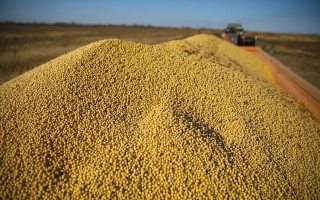
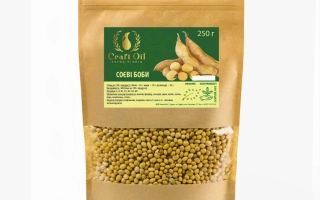
The ALATOM soybean variety is an early-maturing determinate variety developed through selection from a hybrid combination and belongs to the Manshurica subvariety. The plants have a semi-compact shape, low to medium height, with reddish-brown pubescence. The leaves are large, oval-shaped, and light green in color; the flowers are purple, and the pods are light brown. The seeds are elongated with a yellow seed coat and a brown hilum. The mass of 1000 seeds varies from 140 to 168.4 grams, ensuring good density and quality of planting material. The variety is characterized by high yield, reaching 6.8-8.8 centners per hectare in the Altai Krai, which exceeds standard indicators by 0.4-1.6 centners. The protein content in the seeds is 33.0-38.2%, and the fat content is 17.7-19.3%, making this variety particularly valuable for the food industry. During testing, the variety demonstrated disease resistance, increasing the reliability of its cultivation under various conditions. ALATOM is characterized by a vegetative period of 120-130 days and a high yield potential, especially in the late maturity segment. The variety has good stress tolerance and a high branching capacity. Additionally, it demonstrates good tolerance to herbicides with the active ingredient metribuzin, which facilitates weed control and contributes to plant health preservation.