
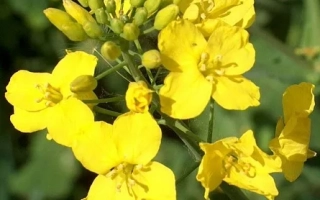

SKU #38995
·
56 views
Amber
Rapeseed
User rating
0 votes0% positive reviews
No ratings yet — be the first.
Type of Rape
Spring Rapeseed
Hybrid Type
Variety (population)
Plant; height
110-120 cm
Oil Content
40-45%
Prices in stores
from50.12 €per 1 kg
pack from 50.12 € per 1 l
1 offer from 1 store
Store offers · 1 from 1 stores
Prices are updated on loadLoading offers…
Available at: Agromen
Aggregator catalog: prices are collected automatically from store websites, normalized by AI and converted at the current exchange rate. Before ordering, confirm the price and availability on the store's website. This block is not indexed by search engines — the data is loaded after the page opens.
About product

Amber is a spring rape variety developed by inter-varietal hybridization using the combination of Yavar x (Hana x Global) followed by individual selection in the F3 generation. Plants of this variety have a semi-compact type, stem height of 110-120 cm with characteristic anthocyanin pigmentation. The variety is characterized by high yield — on average 28.0 c/ha, with maximum yields reaching 42.4 c…
Type of Rape
Spring Rapeseed
Hybrid Type
Variety (population)
Plant; height
110-120 cm
Oil Content
40-45%
Description
Amber is a spring rape variety developed by inter-varietal hybridization using the combination of Yavar x (Hana x Global) followed by individual selection in the F3 generation. Plants of this variety have a semi-compact type, stem height of 110-120 cm with characteristic anthocyanin pigmentation. The variety is characterized by high yield — on average 28.0 c/ha, with maximum yields reaching 42.4 c/ha. The oil content of the seeds is 40.0%, with erucic acid content not exceeding 0.26%, and glucosinolates less than 1.0%. Amber is resistant to lodging, which helps preserve yield and facilitates harvesting.
For successful cultivation of the Amber variety, strict adherence to agronomic requirements is necessary. Seeds must be of high quality with moisture content around 12% and used no later than one month after storage. Prior to sowing, seeds are recommended to be treated with fungicides and insecticides for protection against diseases (alternaria, false powdery mildew, root rots) and soil pests. Sowing is conducted in the first half of April to a depth of 2-4 cm, depending on soil moisture, in row or wide-row method with seeding rates of 9-12 kg/ha and 6-8 kg/ha respectively. An important element of the technology is proper crop rotation: the best preceding crops are leguminous crops, winter wheat, and corn, while rapeseed should not be sown after other cabbage crops. Rapeseed should not be returned to the same field earlier than 4 years, and if sugar beet is present in the crop rotation — at least 5-6 years.
Soil preparation includes autumn plowing to a depth of 27-30 cm with preliminary application of soil herbicide, and spring pre-sowing cultivation and field leveling. Fertilizer application plays a key role: potassium and phosphorus are applied under the main tillage, while nitrogen fertilizers are applied under spring cultivation. Recommended rates are 120-150 kg/ha nitrogen, 90-120 kg/ha phosphorus, and 150-180 kg/ha potassium. To enhance plant resistance and improve photosynthesis, a manganese microfertilizer can be applied, which promotes absorption of other microelements and strengthens the health of rapeseed under stressful conditions.
For successful cultivation of the Amber variety, strict adherence to agronomic requirements is necessary. Seeds must be of high quality with moisture content around 12% and used no later than one month after storage. Prior to sowing, seeds are recommended to be treated with fungicides and insecticides for protection against diseases (alternaria, false powdery mildew, root rots) and soil pests. Sowing is conducted in the first half of April to a depth of 2-4 cm, depending on soil moisture, in row or wide-row method with seeding rates of 9-12 kg/ha and 6-8 kg/ha respectively. An important element of the technology is proper crop rotation: the best preceding crops are leguminous crops, winter wheat, and corn, while rapeseed should not be sown after other cabbage crops. Rapeseed should not be returned to the same field earlier than 4 years, and if sugar beet is present in the crop rotation — at least 5-6 years.
Soil preparation includes autumn plowing to a depth of 27-30 cm with preliminary application of soil herbicide, and spring pre-sowing cultivation and field leveling. Fertilizer application plays a key role: potassium and phosphorus are applied under the main tillage, while nitrogen fertilizers are applied under spring cultivation. Recommended rates are 120-150 kg/ha nitrogen, 90-120 kg/ha phosphorus, and 150-180 kg/ha potassium. To enhance plant resistance and improve photosynthesis, a manganese microfertilizer can be applied, which promotes absorption of other microelements and strengthens the health of rapeseed under stressful conditions.
Crop & resistance
Disease resistance
Specifications hover over for a hint about the specification
|
Type of Rape
Type of Rape
Winter rape is a long-day plant, characterized by weak winter hardiness. It may be damaged at temperatures of -8 to -10°C, so it is most commonly grown in regions with mild winters. The most favorable temperature for growth and development of rape is 18-24°C. It requires moisture... |
|
|---|---|
| Hybrid Type | |
| Plant; height | 110-120 cm |
| Oil Content | 40-45% |
|
Glucosinolate Content, mmol
Glucosinolate Content, mmol
The second criterion for evaluating modern rapeseed varieties is the content of glucosinolates in dry fat-free matter, expressed in various units, for example, %, mg/g, μmol/g. Different countries have different standards for glucosinolate content, as it has been established that... |
9-10 |
|
Erucic Acid Content
Erucic Acid Content
The amount of erucic acid is assessed as a percentage of the total fatty acid content in seed oil. Initially, rapeseed varieties containing less than 5% erucic acid in their seeds were named low-erucic or "0" varieties. Later, this threshold was changed, and "0" varieties now ref... |
|
| Yield Potential | 20-30 ц/га, 30-40 cu/m, 40-50 ц/га |
| Registration year | 1984 |
| Catalog | Catalog → Rapeseed |
| Legal data |
Show · 1
|
| Country | Ukraine |
Not yet комментариев. Be the first!
Alternatives
Rapeseed seeds · similar varieties


See also
Often considered together with this variety




Recently viewed
Products you’ve viewed on this site
Reviews · 0