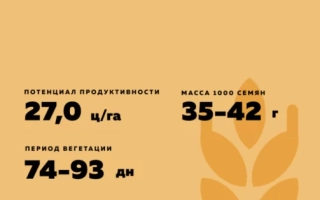
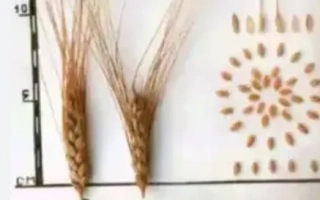
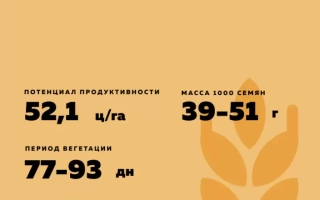
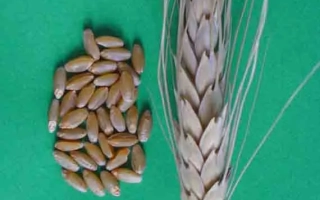
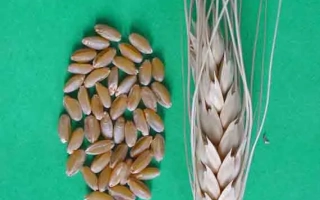
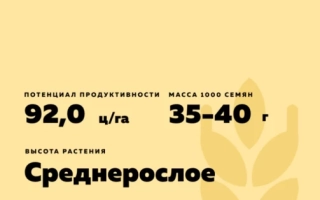
YUNATA is a variety of hard spring wheat (Triticum durum Desf.) intended for cultivation in the Central and Southern zones of the Irkutsk Region. It belongs to medium-early varieties with a vegetation period of 79-96 days, maturing slightly later than the Tulunskaya 12 variety and earlier than the Zhemchuzhina Sibiri variety. The plant is medium-height, with a semi-erect bush and medium straw thickness, which has weak or absent pubescence on the upper node. The ear is cylindrical, dense, with long white awns, and the grain is elongated and light. The mass of 1000 grains varies from 37 to 43 grams, which corresponds to the standards for this variety.
The YUNATA variety demonstrates drought resistance at the level of the standard and exceeds the resistance to lodging of the Tulunskaya 12 variety by approximately one point. Under field conditions, it is moderately resistant to brown rust and weakly affected by powdery scab, however, it is susceptible to powdery mildew and septoria. Average yield in recommended regions is about 22.2 centners/ha, while in the Irkutsk Region, a maximum yield of up to 50.7 centners/ha was recorded. Compared to the Tulunskaya 12 variety, YUNATA shows a yield increase of 4.1 centners/ha.
This wheat variety has satisfactory pasta qualities, making it suitable for the production of pasta. Thanks to its agronomic characteristics and adaptation to regional climatic conditions, YUNATA is a reliable choice for agricultural production, providing a stable yield and grain quality.