


SKU #3794
·
647 views
Sweet cherry Black Dabera
Cherry, Sour Cherry
Type of Variety
Sweet cherry
Your mark
0 votes
0% positive ratings
Store offers · 5 from 5 stores
5 offers in 5 stores — from 5.33 € per seedling.
Available at: biolocus-plant-pro · irkutsk-legendi-rastenii-ru · Plodkr · rassadacvetov-ru · scsadovod-ru
Prices are collected automatically from store websites and converted at the current exchange rate. Check the price and availability on the store website before ordering.
Description
(Southern Coast, Southern Coast Red, Bigarreau Dabera)
This cherry, discovered as a chance seedling around 1862 in Gurzuf (Crimea) by gardener A. Dabera, was introduced into cultivation in the North Caucasus and Lower Volga regions since 1947.
The tree is medium- or strongly-growing, with a dense, broadly rounded crown. Leaves are elongated-oval, with rounded bases and gradual tapering to the apex; petioles bear two dark-red glands near the leaf blade base. Flowers occur in clusters of 2–3, large — 35 mm, with broadly oval, slightly wrinkled petals; calyx 6 x 6 mm, broad-bowl-shaped; stamens 6–13 mm, stigma 12 mm, stigma style positioned below the anthers.
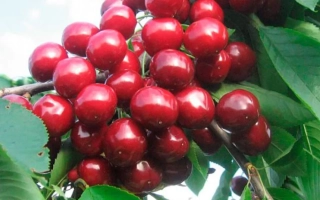
Fruits are large, with a wide depression, weighing 6–6.6 g, broadly heart-shaped with blunt apex, slightly ribbed, black-red with pink subcutaneous dots, distinct seam line, and a bump across the ventral seam and a groove along the dorsal side. Flesh is dark-red, becoming tender as it ripens, with excellent sweet flavor and slight acidity; juice color is intense red. Fruits contain 19.0% dry matter, 13.6% sugars, 0.8% free acids, and 7.3 mg ascorbic acid per 100 g fresh weight. Stone is fairly large, weighing 0.45 g, oval-egg-shaped, accounting for up to 7% of fruit mass, poorly separates from flesh. Peduncle is about 40 mm, moderately attached to the fruit.
Plants begin fruiting at age 5. Flowering occurs at medium time; ripening is medium-late (end of June — beginning of July). Best pollinators include: Gedelfing, Jabule, Bigarreau Goshé, Ramon Oliva, Golden, Francis, Cassini Early, Black Eagle, etc. The variety is characterized by good productivity: in Crimea, at age 16, trees yield up to 90 kg fruit, maximum 170 kg; in Krasnodar Krai, 70–80 kg during full fruiting. Black Dabera is an excellent dessert cherry variety, with fruits maturing simultaneously on the tree.
The variety does not exhibit high winter hardiness; in unprotected locations, it freezes: vegetative parts are damaged up to 2 points at -30.3°C, flower buds up to 72% (average) and up to 83% (maximum) at -24°C. In normal years, it is moderately affected by fungal diseases; in favorable conditions for disease development, it is significantly affected: by coccomycosis up to 4, moniliosis — 2, and clasterosporiosis — up to 4 points.
Advantages: excellent dessert qualities of fruit, good productivity.
Disadvantages: fruits are susceptible to gray rot.
Video · 4 videos
Suggest a video →Crop & resistance
Crop
Specifications
| Type of Variety | |
|---|---|
| Catalog | Catalog → Cherry, Sour Cherry |
No reviews yet. Be the first to share your experience.
Alternatives
Cherry saplings · similar varieties


See also
Often considered together with this variety



Recently viewed
Products you’ve viewed on this site
Reviews