



SKU #4324
·
281 views
Early Dawn
Plum
User rating
0 votes0% positive reviews
No ratings yet — be the first.
Type of Sort
Chinese Loquat
About product

This variety was obtained by G.T. Kazymin at the Far Eastern Research Institute of Agriculture from seeds of the Far Eastern Dessert variety, pollinated freely with the Shiro variety. It was released in the Khabarovsk Krai in 1965. The tree is bushy, of medium growth vigor. The crown is sparse, with sparse branching. The fruit wood is in the form of shortened branches and clusters. The crown shap…
Type of Sort
Chinese Loquat
Description
This variety was obtained by G.T. Kazymin at the Far Eastern Research Institute of Agriculture from seeds of the Far Eastern Dessert variety, pollinated freely with the Shiro variety. It was released in the Khabarovsk Krai in 1965.
The tree is bushy, of medium growth vigor. The crown is sparse, with sparse branching. The fruit wood is in the form of shortened branches and clusters. The crown shape is vase-like, with branches deviating sideways and slightly bending downward. The trunk is of medium thickness, poorly expressed, as the skeletal branches emerge close to the root collar. The branches are fairly thick and sturdy, hardly bending under the weight of the fruit. One-year shoots are of medium thickness, smooth, reddish-brown, with a coating, green on the underside. Fruit buds form on one-year shoots and cluster branches. Fairly large, dark brown, slightly protruding from the shoot, cold-resistant. Leaves are fairly large (up to 10 cm), egg-shaped with a pointed tip. Leaf blade is dark green, smooth, leaf margin doubly serrated. No stipules. Leaf petiole is green and short. Flowers are small — 15 mm in diameter, arranged in clusters on shoots. Petals are white, oval-shaped, moderately open. Calyx is narrow-ribbed. Stigma is positioned above the stamens.
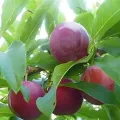
Fruits are medium-sized (average weight 25 g, maximum 31 g). Fruit surface is uneven and angular. Shape is egg-shaped and irregular. The seam is deep and wide. Main color is yellow with greenish tinge, with a small orange blush near the pedicel. Flesh is yellow, slightly fibrous, juicy, sweet, with a slight acidity from the skin. Chemical composition: dry matter — 11.8%, acids — 1.4%, tannins — 5.6%. Pit is medium-sized (1.2 g), egg-shaped and round, slightly mottled. Easily separates from the flesh.
Fruits ripen by August 20, harvesting continues until August 25. They are kept fresh for 7 days. Transportability is weak. The variety is intended for dessert use. Taste evaluation of the fruit is 3.5 points.
Self-sterile, pollinators are the varieties Early Khabarovsk and Far Eastern Yield. The tree begins fruiting in the 3rd year of grafting, mass fruiting from the 5th to 7th year. Yield in early fruiting years — 5-7 kg per tree, in mass fruiting — 25-30 kg. Annual fruiting.
The variety is relatively resistant to rubella and shot hole disease, moderately damaged by fruit moth. Good winter and frost resistance. Due to late flowering, no damage from late frosts occurs. Fruit buds are cold-resistant, flowers are not damaged by spring frosts. No root collar rot occurs.
Advantages of the variety: relatively winter- and frost-resistant trees. Large fruits with good flavor, easily detachable pits. The variety is used in breeding as a parent form.
Disadvantages: due to yellow color, fruits quickly lose market appearance. Low yield.
Crop & resistance
Crop
Disease resistance
Specifications
| Type of Sort | |
|---|---|
| Catalog | Catalog → Plum |
Store offers
Prices are updated on loadLoading offers…
Aggregator catalog: prices are collected automatically from store websites, normalized by AI and converted at the current exchange rate. Before ordering, confirm the price and availability on the store's website. This block is not indexed by search engines — the data is loaded after the page opens.
Not yet комментариев. Be the first!
Alternatives
Plum saplings · similar varieties


See also
Often considered together with this variety


Recently viewed
Products you’ve viewed on this site
Reviews · 0