


SKU #4334
·
299 views
European plum Harvesting Far Eastern
Plum
Type of Variety
Chinese plum
Your mark
0 votes
0% positive ratings
Store offers · 7 from 7 stores
7 offers in 7 stores — from 0.12 € per seedling.
Available at: fedchishina-art-com-ua · Foody · metr-com-ua · oleomac-ua · Omega-Art · Optoweek · Zakladka
Prices are collected automatically from store websites and converted at the current exchange rate. Check the price and availability on the store website before ordering.
Description
This variety was obtained by G.T. Kazymyn in the Far Eastern Research Institute of Agriculture in 1966 from crossing Primorsky x Chinese Plum. It was approved for use in 1985 in the Khabarovsk and Primorsky regions, and is also found in the Amur region.
The tree is weak-growing (height 2.8 m, crown diameter 3.6 m), bushy, with a round-extended, drooping, weeping crown; skeletal branches are thin and branch off at a 90º angle. Shoots are thin, numerous, greenish-brown. Fruit buds are numerous, lagging behind the shoots, forming on one- to two-year-old wood and on medium-sized flower clusters. Buds are dark brown. No winter damage occurs. Leaves are medium-sized, inversely egg-shaped with a pointed apex and base. Leaf blade is thin, light green. Petiole is medium-sized, green. Flowers are small, petals white, irregularly wedge-shaped, moderately open. Pedicel is short. Calyx is narrow-bowl-shaped. Stigma is thin, taller than the anthers.
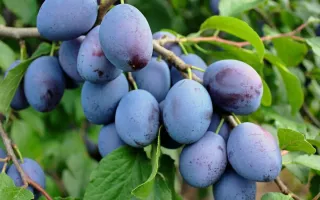
Fruits are medium-sized (average weight 22 g, maximum 28.5 g), elongated-round in shape, slightly flattened towards the seam. Lower depression is shallow. Seam is small but wide. Color is dark red, almost uniform. Flesh is yellow, juicy, fibrous, dense, with a pleasant sweet-sour taste. Flesh quality is good. Sugar content — 9.9%, dry matter — 14.0%, acids — 1.3%, tannins — 0.28%. Pit is medium-sized (0.9 g), oval-shaped with a pointed tip, lagging behind. Variety is suitable for fresh consumption and making jams and compotes. Sensory rating of fruits — 4 points. Transportability is average.
Self-sterile variety. Best pollinators — Amur Early, Dawn Early. Blooming occurs in mid-May. Fruit set begins on the second to third year of grafting, mass fruiting occurs on the fifth to sixth year. Fruits ripen by the end of the third decade of August. Yield is annual and stable. In early years, yield is 5-6 kg per tree; a ten-year-old tree can produce 35-40 kg of fruit. Highly winter-hardy and sunburn-resistant, drought-tolerant, but susceptible to overwatering when planted without a planting pit. Damage from brown rot and spot disease is minimal. Due to its compact crown, it is suitable for use in intensive orchards.
Advantages of the variety: fruit taste qualities are similar to European varieties of domestic plum; relatively resistant to fruit borers.
Disadvantages: small fruit size, insufficient tree longevity.
Video · 1 video
Suggest a video →Crop & resistance
Crop
Disease resistance
Pest resistance
Specifications
| Type of Variety | |
|---|---|
| Catalog | Catalog → Plum |
No reviews yet. Be the first to share your experience.
Alternatives
Plum saplings · similar varieties


See also
Often considered together with this variety



Recently viewed
Products you’ve viewed on this site
Reviews