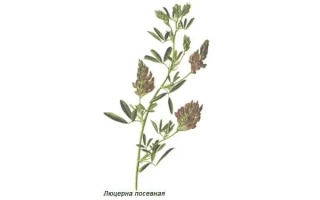
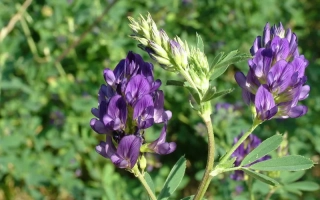
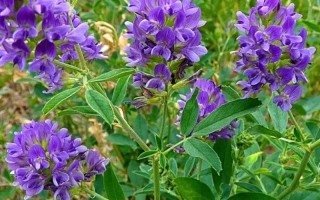
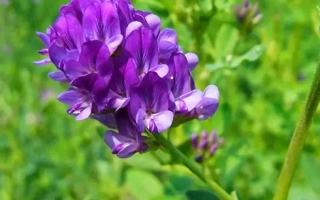
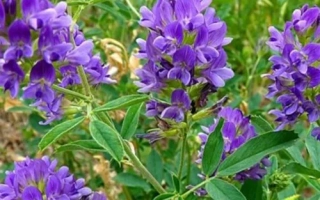
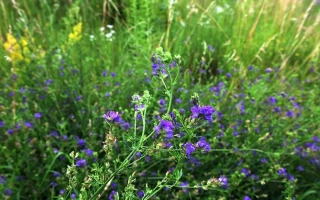
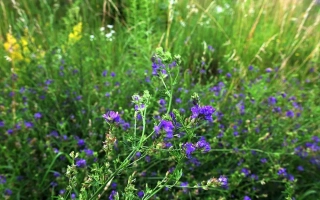
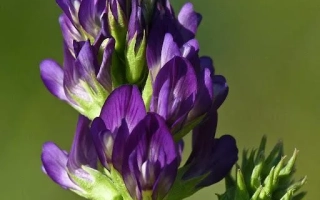
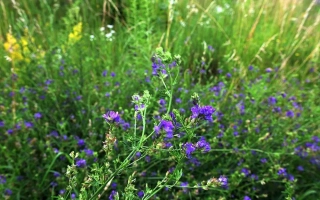
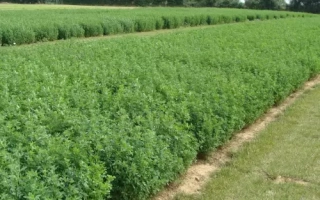
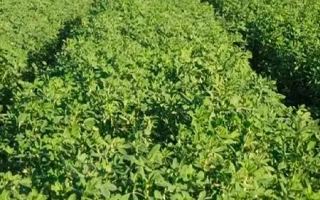
Blue Clover variety Paola is a medium-early tetraploid Italian selection included in the State Register for the Central and Central Chernozem regions of Russia. Plants are characterized by a semi-erect growth habit, average height of about 83 cm in spring, and early-to-medium flowering. Leaves have a medium-dark green coloration, with a central leaflet of medium length and width. Flowers are predominantly dark blue-violet, with very low or absent frequency of cream, white, or yellow flowers. The variety exhibits stable average yields: in the Central region, it reaches about 65.6 c/ha, and in the Central Chernozem region — 77.7 c/ha, with maximum yields reaching 161.8 c/ha and 136.3 c/ha respectively. Dry matter content in plants is higher than standard levels, ranging from 29.6% to 36.7% depending on the region.
Paola possesses high resistance to adverse climatic conditions, including frost, drought, and heat, as well as to major clover diseases. Plants quickly regrow in spring and after cutting, allowing for 2 to 5 cuts per season. Excellent leaf-to-stem mass ratio (leaves about 51%) ensures good feed quality, making the variety popular for animal feeding. It is recommended to sow clover early spring (April–May) or late summer (up to August 15) with a seeding rate of 20–25 kg/ha.
For successful cultivation of Paola variety, it is important to consider agronomic requirements: it does not tolerate acidic soils with pH below 5.5 and performs better on soils following cereal crops. At sowing, it is recommended to apply up to 120 kg/ha of phosphorus-potassium fertilizers to ensure optimal plant nutrition. Thanks to its adaptive properties, high productivity, and feed quality, blue clover Paola is a promising variety for agricultural use in the specified regions.