


SKU #73471
·
51 views
MANCHAARY
Lomkocolosnik
User rating
0 votes0% positive reviews
No ratings yet — be the first.
Culture Type
Forage
Assignment
Feed
Registration year
1994
About product

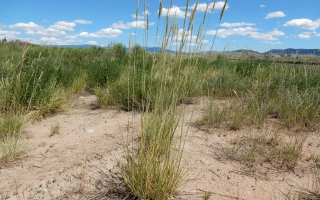
A reliable choice for creating long-term forage fields in extreme temperature conditions.
Culture Type
Forage
Assignment
Feed
Registration year
1994
Description
A Northern Standard for Forage Production
The Manchary wildrye (lomkokolosnik) is the result of long-term selection by the Yakut Scientific Center of the Siberian Branch of the Russian Academy of Sciences, developed specifically for extreme environments. Unlike typical cereal grasses, this variety is adapted to a sharply continental climate with critical temperature fluctuations and moisture deficiency.
Strengths: Adaptability and Resilience
- Extreme Winter Hardiness: The variety successfully tolerates deep soil freezing, characteristic of Far North regions.
- Drought Tolerance: The root system effectively utilizes even scarce precipitation, making it indispensable on saline and eroded soils.
- Nutritional Value: During the tillering and shooting phases, the plant possesses a high protein content, which is crucial for producing high-quality hay and green mass.
Application and Practicality
This crop is focused on creating long-term pastures and hayfields. The main advantage of Manchary over its analogs is its ability to regrow rapidly after mowing and maintain productive longevity for up to 8–10 years in the same location. However, it is important to note that the variety requires careful soil preparation during sowing, as the seeds have a specific husk that requires precise planting depth.
Who is this variety for? Agricultural holdings and farms in high-risk farming zones that need stable forage without the need for annual reseeding. Manchary represents an investment in biological system stability when other perennial grasses fail due to climatic stress.
Specifications
| Culture Type | |
|---|---|
| Assignment | |
| Registration year | 1994 |
| Catalog | Catalog → Lomkocolosnik |
| Legal data |
Show · 1
|
| Country | Russia |
Store offers
Prices are updated on loadLoading offers…
Aggregator catalog: prices are collected automatically from store websites, normalized by AI and converted at the current exchange rate. Before ordering, confirm the price and availability on the store's website. This block is not indexed by search engines — the data is loaded after the page opens.
Not yet комментариев. Be the first!
Alternatives
Lomkocolosnik · similar varieties


See also
Often considered together with this variety




Recently viewed
Products you’ve viewed on this site
Reviews · 0