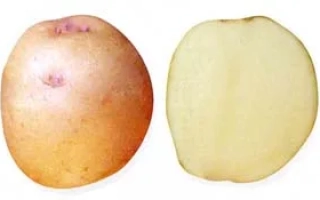
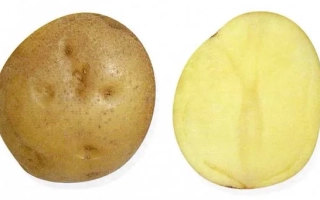
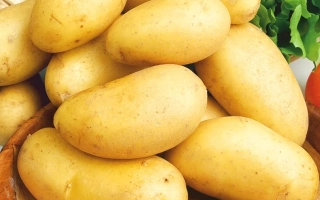
Mars potato is a medium-early table variety with a maturation period of 65 to 80 days. Tubers have an oval-round shape, smooth yellow skin, and light-yellow flesh. The weight of marketable tubers ranges from 82 to 174 grams, and the number of tubers per plant reaches 7-12. The starch content is 10.1-15.2%, meeting the standards of the Nevsky variety. The taste qualities are good, culinary type AB, making it versatile for soups, salads, and frying. The tubers have high storability — 94% — ensuring long-term storage without quality loss.
The plant is of medium height, intermediate type with semi-erect growth. Leaves are medium-sized, open, green, with no or very slight leaf margin waviness. The flower corolla is medium-sized and white. The yield of the variety is stable and high — from 177 to 340 centners per hectare, with maximum yields reaching 382 centners, significantly exceeding the standards of the Nevsky variety. The tuber marketability ranges from 80-96%, indicating high product quality.
The Mars variety exhibits good resistance to several diseases, including potato cancer, leaf curl virus, crinkly and striped mosaic. It is also weakly affected by golden cyst-forming potato nematode. However, the variety is moderately susceptible to late blight on foliage and susceptible on tubers, requiring attention during cultivation. The breeder of the variety is the Federal State Unitary Enterprise "VNIISK Potato Husbandry" named after A.G. Lorha. The main advantages of the variety are stable high yield, high marketable tuber output, good taste qualities, and excellent storability.