


SKU #72739
·
67 views
NIKITSKY WHITE HYSSOP
Hyssop
User rating
0 votes0% positive reviews
No ratings yet — be the first.
Herbs
Hyssop
Flavor and Aroma
Spicy
Registration year
2014
About product

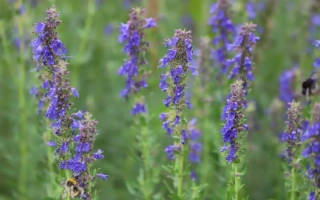
Nikitsky white hyssop – a compact semi-shrub up to 55 cm in height and about 65 cm in diameter, easily fitting into landscape compositions as a fragrant border or decorative element of a flowerbed. Its upright stems are covered with lace-like white flowers, creating the impression of thin paper; meanwhile, the plant emits a spicy aroma that envelops the entire flowerbed and enhances the atmosphere…
Herbs
Hyssop
Flavor and Aroma
Spicy
Registration year
2014
Description
Nikitsky white hyssop – a compact semi-shrub up to 55 cm in height and about 65 cm in diameter, easily fitting into landscape compositions as a fragrant border or decorative element of a flowerbed. Its upright stems are covered with lace-like white flowers, creating the impression of thin paper; meanwhile, the plant emits a spicy aroma that envelops the entire flowerbed and enhances the atmosphere of a summer garden.
The vegetative cycle of hyssop begins in the first–second decade of March, while flowering starts in the third decade of June – early July. The most intensive flowering period occurs in July, followed by fruiting in the second decade of August and September. The flowering duration is 75–80 days, and the total time from the start of vegetation to seed maturity is about 160 days. The plant grows well on light, drained soils and does not tolerate saline or waterlogged areas.
Nikitsky white hyssop possesses many useful properties: its foliage and flowers are used in medicine to treat bronchi, eyes, and the cardiovascular system; they are also often added to tea and used as a spice for dishes. The collection of aerial mass is carried out at the beginning of flowering, when the essential oil content reaches its maximum (0.45% of fresh mass), allowing to obtain about 51.3 kg/ha of essential oil with the main component isopinocamphone (71.1%). The plant is easily propagated by seeds and vegetative means; its seeds retain germination up to 80–90% after six months of storage at 22 °C. The best time for cuttings is February–March. Thanks to its light-loving, drought-resistant, and winter-hardy nature, Nikitsky white hyssop becomes a valuable element both in decorative and medicinal-culinary use.
The vegetative cycle of hyssop begins in the first–second decade of March, while flowering starts in the third decade of June – early July. The most intensive flowering period occurs in July, followed by fruiting in the second decade of August and September. The flowering duration is 75–80 days, and the total time from the start of vegetation to seed maturity is about 160 days. The plant grows well on light, drained soils and does not tolerate saline or waterlogged areas.
Nikitsky white hyssop possesses many useful properties: its foliage and flowers are used in medicine to treat bronchi, eyes, and the cardiovascular system; they are also often added to tea and used as a spice for dishes. The collection of aerial mass is carried out at the beginning of flowering, when the essential oil content reaches its maximum (0.45% of fresh mass), allowing to obtain about 51.3 kg/ha of essential oil with the main component isopinocamphone (71.1%). The plant is easily propagated by seeds and vegetative means; its seeds retain germination up to 80–90% after six months of storage at 22 °C. The best time for cuttings is February–March. Thanks to its light-loving, drought-resistant, and winter-hardy nature, Nikitsky white hyssop becomes a valuable element both in decorative and medicinal-culinary use.
Crop & resistance
Crop
Specifications
| Herbs | |
|---|---|
| Flavor and Aroma | |
| Registration year | 2014 |
| Catalog | Catalog → Hyssop |
| Legal data |
Show · 9
|
| Country | Russia |
Store offers
Prices are updated on loadLoading offers…
Aggregator catalog: prices are collected automatically from store websites, normalized by AI and converted at the current exchange rate. Before ordering, confirm the price and availability on the store's website. This block is not indexed by search engines — the data is loaded after the page opens.
Not yet комментариев. Be the first!




See also
Often considered together with this variety

Healer
Сельскохозяйственное Селекционно-производственное Предприятие Сортсемовощ
060 1 offer
1 040 €per 1 kg ≈ 53 574 ₴





Recently viewed
Products you’ve viewed on this site
Reviews · 0