Summer variety selected by VNIISPK, obtained by crossing the varieties Bergamot Novik and Lyubimitsa Klappa in 1977. Breeders: E. N. Sedov, A. G. Kuznetsova, N. G. Krasova. Approved for the Central Chernozem region, mainly grown on private and dacha plots. Of interest for commercial plantations.
Trees large, with dense pyramidal crowns. Branches diverge from the trunk at a sharp angle. Bark on the trunk and main branches smooth, gray. Predominant type of fruit formations — simple and complex rings.
Shoots thick, weakly jointed, curved, round in cross-section, brown, hairy at the tips. Few buds on the shoots. Buds are bent, conical, smooth. Leaves large, elongated, elliptical, short-pointed, with spirally twisted tips, dark green, smooth, shiny, with delicate venation, slightly curved along the central vein. Leaf blade concave, without hairs. Leaf margin finely serrated, wavy, rolled. Petiole long, without hairs.
Flower buds smooth, large, elongated-conical. Flowers white, large or medium-sized, sometimes double, saucer-shaped, petals round, touching each other, stigma level with stamens.
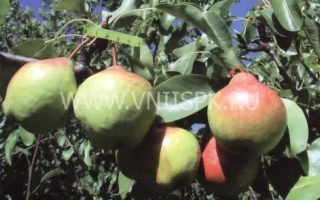
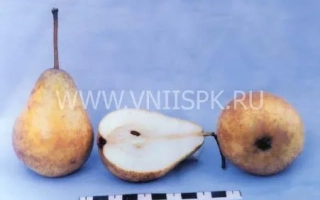
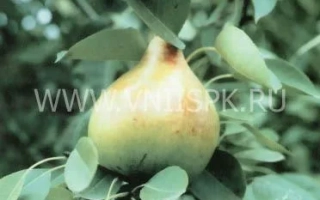
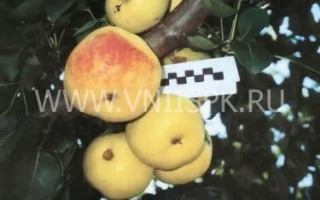
Fruits of medium size (150 g), one-dimensional, pear-shaped, wide-ribbed, slanted. Fruit skin smooth, oily, dull. Main fruit color is greenish at harvest and greenish-yellow at consumer ripeness. Cover color on the sun-exposed side appears as a blurred brownish-red or red blush. Many lenticels, small, clearly visible. Peduncle long, thick, curved, oblique. Receptacle open. Calyx absent. Fruit core small, bulbous. Seed chambers closed. Subcalyx tube of medium length, narrow, sac-like. Seeds of medium size.
Fruit flesh greenish, juicy, tender, semi-oily, finely granular, usually succulent. Flavor sweet with mild aroma. Appearance attractiveness rating 4.6 points, taste tasting rating 4.5 points. The variety performs better in warm, humid summers; under these conditions, fruits ripen better, become more succulent and sweeter. In cool summers and on poor, insufficiently moist soils, fruits of the Orlovskaya Krasavitsa variety are somewhat dry, accumulate less sugar, and deteriorate in taste. Chemical composition of the fruits: total sugars — 9.2%, titratable acids — 0.21%, ascorbic acid — 3.8 mg/100g, P-active substances — 124.3 mg/100g.
Harvest ripeness of fruits in the Orlovskaya region occurs in early August, i.e., 10-15 days earlier than in Bessemianka. Consumer period lasts 2-3 weeks.
High-yielding variety. Young trees yield an average of 100 centners per hectare, mature trees yield 30-40 kg (150-200 centners per hectare). The variety is sufficiently winter-hardy in the Orlovskaya region. Even in severe winter 1986/1987, when air temperature dropped to -32 to -35°C, minor damage was noted at 1.0 point for the Orlovskaya Krasavitsa variety. For Bessemianka, damage from frost was 0.5 points.
The variety is resistant to fruit and leaf scab. Scab damage on fruits did not exceed 0.2 points and on leaves — 1.1 points even in epidemic years.
Advantages of the variety: early fruiting, high yield, high commercial and consumer quality of fruits at early ripening.
Disadvantages of the variety: slightly dry flesh in some years.