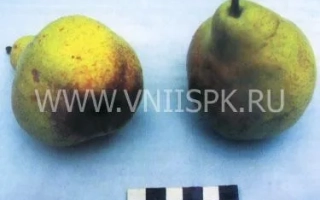
Late-season variety selected by SKNII GIPS from hybridization of Bere Ardanpon with Lyubimitsa Klappa. Breeders: P. P. Kostyak, A. I. Terechenkova. Approved for the North Caucasus region. Cultivated in the North Caucasus zone: Kabardino-Balkaria, Dagestan, Ingushetia, Chechnya.
Trees of medium growth vigor. Young trees have a pyramidal crown, which becomes inversely pyramidal with age, of medium density, well-leafed. Bark on the trunk is gray and flaking. Main branches are greenish-gray and arranged at an oblique-vertical angle. Fruit-bearing type is mixed. Bears fruit on ring buds, fruiting spurs, and spur-like branches located on two-year-old, as well as three- to four-year-old wood.
Shoots are reddish-brown, straight, shorter than average, round, without pubescence, internodes relatively short. Buds are small, sparse, located at surface level. Buds are brown, slightly deviated from shoots, conical.
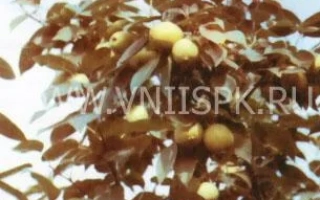
Leaves are green, elongated (sometimes oval), with a pointed base and finely serrated edges, smooth surface. Leaf blade is slightly concave, stiff, without pubescence, matte. Leaf position relative to stem is nearly perpendicular on long petioles, with small lanceolate stipules.
Flowers are relatively large; have a white, funnel-shaped corolla with long, unpubescent pistil styles, stigma positioned level with anthers.
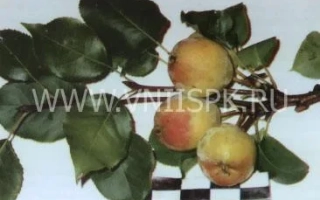
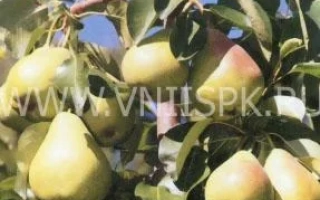
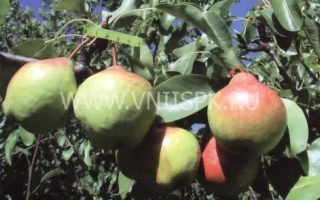
Fruits are above average size, relatively one-dimensional, pear-shaped, weakly ribbed. Surface is smooth. Skin is thin, smooth, dry, slightly oily when stored. Color at harvest is light green with faint blush, during storage fruits turn greenish-yellow with purple blush on the lower part of the fruit. Few small, greenish-gray, barely noticeable lenticels. Individual fruits may show rust-like streaks. Peduncle is medium length and thickness, slightly curved, without depression. Calyx is small, medium-sized, slightly ribbed. Central cavity is absent. Seed cavity is medium, elliptical. Many seeds, medium size, brown.
Flesh is yellowish-white, juicy, tender, semi-oily, with good (4.3 points) slightly tart-sweet flavor. Appearance rating: 4.5 points.
Fruits contain 10.4% sugar, 0.28% titratable acid, 2.4 mg/100g ascorbic acid.
Harvest maturity occurs 17-20 August; consumer period from 22 August to 15 November. Vegetation ends in late October to early November. Fruit drop is weak. Transportability and marketability of fresh fruits are moderate. Dessert variety, promising for processing into juice.
Partially self-fertile. Best pollinators: Williams, Lyubimitsa Klappa.
Trees begin fruiting on vigorous rootstocks at 6 years, and on 'A' rootstock at 4 years. In Kabardino-Balkaria, at ages 13-20 years, average yield was 370 centners/ha on wild Caucasian pear rootstock. In Dagestan, on 'R3' rootstock, yield was 413 centners/ha (M. M. Mursalov et al., 1999). Fruit-bearing is regular.
Moderately resistant to extreme environmental conditions. Winter-hardy, drought resistance moderate. Moderately resistant to diseases, but susceptible to pests. Pest damage from scab during epiphytotic years averaged 1.3 points.
Advantages of the variety: good ecological adaptability, early fruiting, high yield, good fruit flavor.
Disadvantages of the variety: fruit size reduction under heavy fruit load.