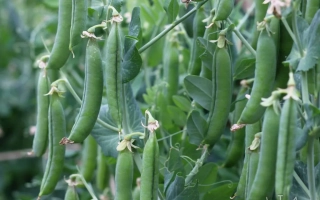
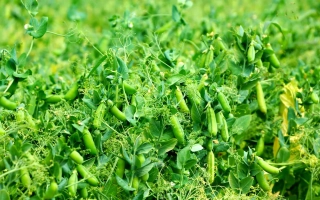
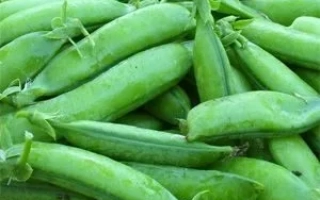
The KUMIR pea variety is a medium-early leafless variety developed by breeders of the FGBUN FCI Tyumen Scientific Center of the Siberian Branch of the Russian Academy of Sciences. It is characterized by a vegetative period of 65 to 87 days and plant height ranging from 44-103 cm. The plants have an average number of nodes to the first fertile node, well-developed stipules, and low mottling density. Flowers are white, with up to two flowers per node. Pods are straight or slightly curved with an acute tip, and seeds are angular-rounded with yellow cotyledons and a light hilum. KUMIR is distinguished by high yield, which varies across regions from 9.3 centners per hectare in the Urals region to 16 centners per hectare in the Western Siberian region, reaching 18.7 centners per hectare in Tomsk Oblast, which exceeds standard varieties. The maximum registered yield was 48.2 centners per hectare in the Tyumen region. The mass of 1000 seeds ranges from 200 to 256 g, which is 32 g higher compared to benchmark varieties. Protein content in the grain ranges from 23.9-25.4%, making the variety valuable in terms of quality. The variety exhibits moderate drought tolerance and high resistance to lodging and shattering, ensuring yield stability. At the same time, KUMIR is moderately susceptible to ascochitis but highly susceptible to root rots. It is recommended for cultivation in Tomsk Oblast and the Western Steppe zone of the Orenburg Region, confirming its adaptability to various climatic conditions. The variety's pedigree includes lines Erbi and Nord, which contribute to its comprehensive agronomic characteristics.