


SKU #3959
·
350 views
Podbielski
Cherry, Sour Cherry
User rating
0 votes0% positive reviews
No ratings yet — be the first.
Type of Sort
Cherry
Store offers · 3 from 3 stores
Prices are updated on loadLoading offers…
Available at: AgronomVIP · Biosad · Drevolaz · Все Росте
Aggregator catalog: prices are collected automatically from store websites, normalized by AI and converted at the current exchange rate. Before ordering, confirm the price and availability on the store's website. This block is not indexed by search engines — the data is loaded after the page opens.
About product

Kochs Ostheimer, Minister von Podbielski, Kochova, Minister Podbielski, Podbielskaya.
Introduced by K. Koch in Germany at the end of the 19th century from crossing the Griot Ostheimer variety with the Lothow cherry. It was registered in 1947 and included in the State Register for the North Caucasus region.
A strongly growing tree, reaching heights of 5 m and more, forming a beautiful, round…
Type of Sort
Cherry
Description
Kochs Ostheimer, Minister von Podbielski, Kochova, Minister Podbielski, Podbielskaya.
Introduced by K. Koch in Germany at the end of the 19th century from crossing the Griot Ostheimer variety with the Lothow cherry. It was registered in 1947 and included in the State Register for the North Caucasus region.
A strongly growing tree, reaching heights of 5 m and more, forming a beautiful, round, and with age becoming flat-round, heavily leafed crown. The trunk has a fairly smooth, brownish-gray bark with longitudinal cracks; skeletal branches emerge from the trunk at angles of 60-70°, thick, dark brown. Shoots are upright, with fruits hanging downward. Leaves are large — 112 x 65 mm, dark green, matte or slightly shiny, broadly oval or inversely egg-shaped, usually with a sharp transition to the apex, serrated or doubly obtuse-serrated margins; petiole 20 mm; stipules are often absent or small, brown, located 1-2 in the base of the leaf blade. Flowers form in clusters of 3-4 per inflorescence, large, 32 mm, bowl-shaped, with rounded, wrinkled petals having characteristic notches at the base of both sides and a rounded apex, sometimes with a weakly expressed notch. The stigma is positioned at the same level as the stamens. The calyx is cup-shaped, with anthocyanin tinge. The pedicel is 20-25 mm long, fairly thick (2 mm). Fruit set is mixed: 20% of the yield forms at the base of one-year-old branches, 80% forms on flower clusters of 2-3-4-year-old branches.
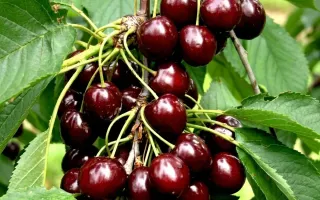
Fruits usually form in clusters of 1-2, large, 22 x 18 x 19 mm, weighing up to 5 g and more (usually 4-5 g), dark red, nearly black, shiny, flat-round, with a rounded apex and a wide, fine pit, the ventral suture sloping toward the apex. Flesh is dark red with light veins, fibrous, tender, tart-sweet, very good, harmonious flavor with a pleasant cherry aroma; juice is intensely red. In the Krasnodar region, fruits contain 15.2% dry matter, 10.7% sugars, 1.2% free acids, and 9.7 mg ascorbic acid per 100 g of fresh weight; in the Lower Volga region: 19.6% dry matter, 10.1% sugars, 1.6% free acids, and 17.0 mg ascorbic acid per 100 g. The stone is medium-sized, 9.4 x 9.0 x 7.8 mm, weighing 0.24 g, making up 8-10% of the fruit's total weight, light brown, broadly round, asymmetric due to the ventral suture being pulled out at the base in the shape of a “beak,” with strongly convex sides, easily detaching from the flesh. The pedicel is 28-37 mm, thick, attaching to the ripe fruit moderately or weakly, detachment is almost dry, with some fruits showing only minimal juice exudation.
Grafted plants begin fruiting on the 3rd-4th year after planting, productivity increases slowly. By flowering time, it belongs to the early group, by ripening — early-mid. In the North Caucasus, fruits ripen on average on June 17, in the Lower Volga region — at the beginning of July. Ripening is not simultaneous. Self-sterile, best pollinators are Early English, May Duke, Griot Ostheimer, Lothow, Anadolskaya, and also cherry varieties. Productivity of the variety is high. In the Krasnodar region, over a 10-year period, from 7- to 16-year-old plants, average yield was 12.2 kg per tree, with a maximum of 40 kg. Podbielski shows very high productivity in Crimea, where over a 10-year fruiting period, 22-31-year-old trees yielded on average 76 kg per tree, with a maximum recorded yield of 145.3 kg per tree. As trees age, fruiting shifts to the crown periphery.
The variety is sensitive to winter cold temperatures, generative buds often freeze during winter, and buds and flowers suffer in spring. Moderately resistant to fungal diseases, highest infection rating — 2-3. Drought and heat resistance is below average — average. Suffers slightly from chlorosis on carbonate soils.
Podbielski is an excellent, high-yielding, and high-quality variety for southern regions of Russia, for areas characterized by mild winters. In more northern regions, it suffers from sunburn and frost cracks, frost damage to one-year-old shoots and generative buds. Morphologically and by nature, it is a cherry-cherry hybrid (2n=40), pentaploid, leaning more toward common cherry. Due to its delicious, high-quality fruits, it belongs to the universal group, its fruits are used for dessert and for producing high-quality processed products; fruit transportability is average.
Advantages: excellent taste qualities of fruits for dessert and technical purposes, relatively field resistance to fungal diseases, high productivity.
Disadvantages: insufficient resistance to low negative temperatures, large plant size creates problems with care and harvest.
Video · 1 video
Suggest a video →Crop & resistance
Crop
Specifications
| Type of Sort | |
|---|---|
| Catalog | Catalog → Cherry, Sour Cherry |
Not yet комментариев. Be the first!
Alternatives
Cherry saplings · similar varieties


See also
Often considered together with this variety




Recently viewed
Products you’ve viewed on this site
Reviews · 0