


SKU #3919
·
427 views
Lothowa
Cherry, Sour Cherry
User rating
3 votes100% positive reviews
No ratings yet — be the first.
Type of Sort
Cherry
Prices in stores
from0.01 €per seedling
pack from 5.26 € per 500 pcs
3 offers from 2 stores
Store offers · 3 from 2 stores
Prices are updated on loadLoading offers…
Available at: Semena-online · vistamarket-in-ua
Aggregator catalog: prices are collected automatically from store websites, normalized by AI and converted at the current exchange rate. Before ordering, confirm the price and availability on the store's website. This block is not indexed by search engines — the data is loaded after the page opens.
About product

Schattenmorelle, Lothowa, Lothowka, English Morel, Shadow Morel, Senchesta Morelle, Grosse Lange Lothkirsche, Lutowka Pozna and others.
An old western European variety, widely distributed and therefore known by many synonyms. Its exact origin is unknown. L.P. Simirenko reports that it was cultivated in Holland already in the 16th century. In Russia, it was registered since 1947, but did not ga…
Type of Sort
Cherry
Description
Schattenmorelle, Lothowa, Lothowka, English Morel, Shadow Morel, Senchesta Morelle, Grosse Lange Lothkirsche, Lutowka Pozna and others.
An old western European variety, widely distributed and therefore known by many synonyms. Its exact origin is unknown. L.P. Simirenko reports that it was cultivated in Holland already in the 16th century. In Russia, it was registered since 1947, but did not gain widespread popularity and is more commonly found in the gardens of enthusiasts and collections of research institutions. It was included in the State Register for the Northwestern region (Kaliningrad Oblast).
A medium-sized tree, forming a spreading, drooping, flat-rounded crown of medium density and good foliage. Main branches branch off from the trunk at an angle of 50-75º, with smooth dark brown bark with a grayish tint. One-year-old branches have short internodes, brown with a grayish-white coating. Vegetative and generative buds are not large. Leaves are medium-sized — 78 x 38 mm, narrowly oval, dark green, slightly glossy, folded along the central vein; leaf margin has fine, doubly serrated teeth; glands are medium-sized, round, dark red, arranged 1-2 at the base of the leaf blade; petiole 24 mm long and 2 mm thick. Flowers average 3 per inflorescence, medium-sized — 30-33 mm, bowl-shaped, with broadly oval, wavy, overlapping, rounded petals 13 x 12 mm, with rounded base and forked apex. Stigma 9 mm long, located below the stamens, whose filaments are 6-9 mm long. Pedicel 28-38 mm, green with intense anthocyanin tint. Fruit type is mixed, predominantly on one-year and two-year-old branches, causing the crown to be prone to bareness.
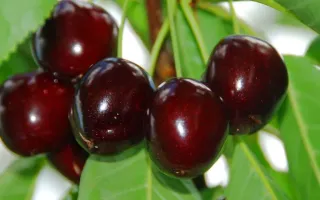
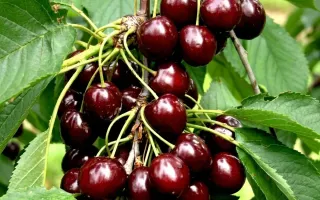
Fruits 19.5 x 17.2 x 17.1 mm, weighing 3.5-4.0 g, heart-shaped, dark red, slightly compressed on the ventral suture, with small and wide cavity. Flesh is dark red, fibrous, juicy, with satisfactory sour taste; juice is red. Fruits contain dry matter — 16.6%, sugars — 11.7%, free acids — 2.1%, ascorbic acid — 19.7 mg per 100 g fresh weight. Stone is medium to large, 9.4 x 7.8 x 6.0 mm, weighing 0.25-0.3 g, making up 5% of fruit mass, egg-shaped, with sharp dorsal and wide, well-developed ventral sutures, wrinkled at the base, partially detachable. Peduncle 45-55 mm, detaches with moist separation; upon full ripening, fruits detach easily. Fruits are excellent raw material for processing into jams, juices, wine, etc.
Plants begin to flower and bear fruit on the 4th-5th year after grafting. Flowering occurs in early-to-mid season, fruiting is late. In the middle zone of Russia, fruits ripen in the first decade to mid-August, slightly earlier than 'Lubskaya' cherry. Ripe fruits can remain on branches for a long time without falling and improve their taste. Productivity in southern areas is good or high; in the Krasnodar region, up to 15 kg per tree at 8-10 years old, and total yield over 18 years of fruiting reached over 260 kg per tree. Self-fertile, produces 16-30% fruit from self-pollination, so single-varietal plantings are possible, but best yields occur in mixed plantings with 'Lubskaya' and 'Podbelsky'. In northern latitudes (St. Petersburg), productivity depends entirely on winter-spring weather conditions, ranging from single fruits to 5-8 kg per tree.
Winter hardiness is good under normal winters, but in harsh winters, branches and generative buds may suffer significant freezing, limiting the variety's distribution to more northern latitudes. The variety is not sufficiently resistant to fungal diseases: in years favorable for their development, it is significantly affected by coccomyces, and in southern areas — moniliosis and clasterosporosis. In moderate cases, it may be affected by cherry slugs.
Lothowa, like 'Lubskaya', is prone to bud mutations. Over a long cultivation period, many clones have been identified, differing in morphological and agronomic traits: ripening time, crown shape and size, etc. (Weeping Lothowa, Late Lothowa, Spreading Lothowa). This is a good industrial variety for regions with warm climates and mild winters.
Advantages: self-fertility, restrained growth of plants.
Disadvantages: insufficient resistance to low negative temperatures and fungal diseases, excessive acidity and astringency of fruits.
Crop & resistance
Crop
Specifications
| Type of Sort | |
|---|---|
| Catalog | Catalog → Cherry, Sour Cherry |
Not yet комментариев. Be the first!
Alternatives
Cherry saplings · similar varieties



See also
Often considered together with this variety


Recently viewed
Products you’ve viewed on this site
Reviews · 0