


SKU #3915
·
415 views
Lada
Cherry, Sour Cherry
User rating
0 votes0% positive reviews
No ratings yet — be the first.
Type of Sort
Cherry
Store offers · 1 from 1 stores
Prices are updated on loadLoading offers…
Available at: Лучший Сад
Aggregator catalog: prices are collected automatically from store websites, normalized by AI and converted at the current exchange rate. Before ordering, confirm the price and availability on the store's website. This block is not indexed by search engines — the data is loaded after the page opens.
About product

This variety was developed at the Rossoshanskaya Zonal Experimental Station for Horticulture by A.Y. Voronchikhina from crossing the varieties Zhukovskaya and Pobeda. In 1995, it was accepted for state variety testing in the Central Chernozem region. It is currently sparingly grown in gardens. The tree is weak- or medium-growing, reaching a height of no more than 3-4 m at 15 years of age; the cro…
Type of Sort
Cherry
Description
This variety was developed at the Rossoshanskaya Zonal Experimental Station for Horticulture by A.Y. Voronchikhina from crossing the varieties Zhukovskaya and Pobeda. In 1995, it was accepted for state variety testing in the Central Chernozem region. It is currently sparingly grown in gardens.
The tree is weak- or medium-growing, reaching a height of no more than 3-4 m at 15 years of age; the crown is oval or rounded, of medium density, with medium leafiness. The bark on the trunk is dark gray or black-gray, with a cherry-like sheen on young trees, slightly shedding, medium- or weakly rough, with no longitudinal cracking or spiral twisting. The buds are weakly convex, elongated or elongated-oval, ranging from very short to long, narrow or medium, arranged with medium density. The branches are straight, with long internodes, initially greenish-brown, then uniformly gray-brown with a silvery tint; the buds are small, round or oval, whitish-rose, arranged with medium density. Vegetative buds are large, 5-6 mm long, conical, with a pointed apex, protruding. Flowering buds are smaller, 4-5 mm long, more egg-shaped than conical, with a pointed apex, set apart. The leaf blade is oval with a pointed apex and rounded or arcuate base, 9-10 cm long, 3-5 cm wide on one-year-old shoots; dark green above, nearly smooth, bare, weakly or moderately concave along the central vein, matte or slightly glossy; pale green below with distinct vein netting, nearly bare, with slight pubescence at the angles of lateral vein departure; fine, double-toothed margin; blade consistency leathery. The petiole is 20-25 mm long, thin, bare or very slightly pubescent above, with weak yellowish-brown anthocyanic coloration; glands are usually 2, medium-sized, pale with a dark spot in the center; stipules absent. In the inflorescence, usually 2-3 flowers, medium-sized, white.
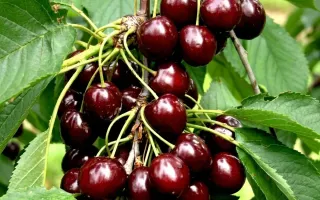
Fruits average 4.9 g in weight, 22 mm in height, 24 mm in width, 21 mm in thickness, heart-shaped, distinctly flattened on the sides, with a narrow, small depression, rounded apex with barely noticeable stigma remnant. Skin color dark red with a broad, lighter band; flesh dark red, uniform, fleshy, fairly dense, juice dark red. Taste sweet with slight acidity, no off-flavors, dessert-like with a tasting score of 4.7 points. Biochemical composition of fruits: 11.8-16.1% soluble solids; 10.3-12.4% sugars, 0.8-1.3% titratable acids, 0.05-0.16% tannins and coloring substances. Peduncle rather long — 45-55 mm, 0.8-1 mm thick, loosely attached to the stone, detachment from ripe fruits is easy and nearly dry, though often a drop of juice exudes at the detachment site. Stone average weight 0.33 g, accounting for 6.7% of fruit weight, oval or egg-shaped, apex uneven, often with a very small tip, base rounded, uncut; fresh stone color pale brownish-yellow with a rosy tinge, separates well from the flesh. Technological qualities of fruits are good: compotes are generally rated 4.4 points for appearance and 4.4 points for taste.
Fruits ripen early, simultaneously or slightly earlier than the Kentskaya variety, usually in the second decade of June in the southern part of the Central Chernozem region. Due to their high taste qualities, fruits are primarily intended for fresh consumption.
Flowering occurs in early to mid-season; the variety is self-fertile, best pollinators are Kentskaya and Chernaya Krupnaya. Trees grafted onto antipka enter fruiting 3-4 years after planting in the garden. High early fruiting; yield increases rapidly: by the sixth year, trees averaged 19.8 kg of fruit, and by age 8 — 40.4 kg. Average yield over the first four years of fruiting was 23.4 kg per tree versus 8.9 kg for the control variety Kentskaya. Due to high winter hardiness of flower buds, Lada produced a high yield — on average 19.8 kg/tree, even after the severe winter of 1978-1979. During full fruiting, average yield over 6 years was 16.9 kg/tree, compared to 13.6 kg for Kentskaya. In the most favorable years, average yield reached 40.4 kg/tree, with individual trees yielding 50-60 kg of fruit.
Winter hardiness of the tree in the southern Central Chernozem region is good. Average degree of freezing even in the most unfavorable winters of 1984-1985 with temperatures dropping to -31.4º and 1986-1987 with an absolute minimum of -36.4º was 2.2 points. In the most severe winter of 1986-1987, 52.4% of flower buds were killed, while in other winters, the percentage of flower bud mortality did not exceed 35%.
Lada is severely affected by coccomyces, and in epidemic years, the average disease rating reaches 4.6 points (2000). Resistance to moniliosis is moderate.
Advantages of the variety: high fruit taste quality, early fruiting, high and regular yield.
Disadvantages: low resistance to coccomyces.
Crop & resistance
Crop
Specifications
| Type of Sort | |
|---|---|
| Catalog | Catalog → Cherry, Sour Cherry |
Not yet комментариев. Be the first!
Alternatives
Cherry saplings · similar varieties


See also
Often considered together with this variety


Recently viewed
Products you’ve viewed on this site
Reviews · 0